.webp&w=1920&q=75)
When Anthropic open-sourced the Model Context Protocol in late 2024, almost nobody in crypto had heard of it. Eighteen months later, the number of live MCP servers for crypto has exploded — every major data provider has shipped one, most exchanges have a community wrapper, and the landscape looks nothing like it did a year ago.
So if you're shopping for a crypto MCP in 2026, where should you point your agent? We compared the main contenders across data coverage, depth, pricing, trust, and fit for AI use cases. This guide is the summary.
We include Cryptohopper in this comparison because — well, we make it. Where there's a feature we're genuinely behind on, we say so. Where we think we're the right answer, we say that too.
The contenders
The crypto MCP space splits into three camps.
Data-first MCPs. These return market data of various kinds — prices, fundamentals, historical candles, sometimes on-chain metrics. No execution.
- Cryptohopper Market Data MCP — live orderbooks, tickers, and candles across most major CEXs.
- CoinGecko MCP — broad price and coin-data coverage, including long-tail tokens and some DeFi coverage.
- CoinMarketCap MCP — similar territory to CoinGecko, stronger on listings/rankings.
- CoinAPI MCP — enterprise-grade aggregated market data, historical depth.
- altFINS MCP — technical-analysis-first offering, packaged indicators.
- CryptoRank MCP — research data (rounds, unlocks, calendar) alongside prices.
Execution-first MCPs. These are wired to one or more exchanges and let an agent place orders.
- Alpaca MCP — crypto + stocks, US-focused, execution-capable via brokerage.
- Various exchange-specific community servers (Binance, Bybit, etc.) — quality varies.
Open-source / bring-your-own-keys.
- CCXT MCP — a server wrapping the CCXT library so agents can call any exchange CCXT supports. Powerful, but you bring your own keys and deal with per-exchange quirks.
Cryptohopper sits in the data-first camp today, with a trade-execution MCP on the roadmap.
The comparison matrix
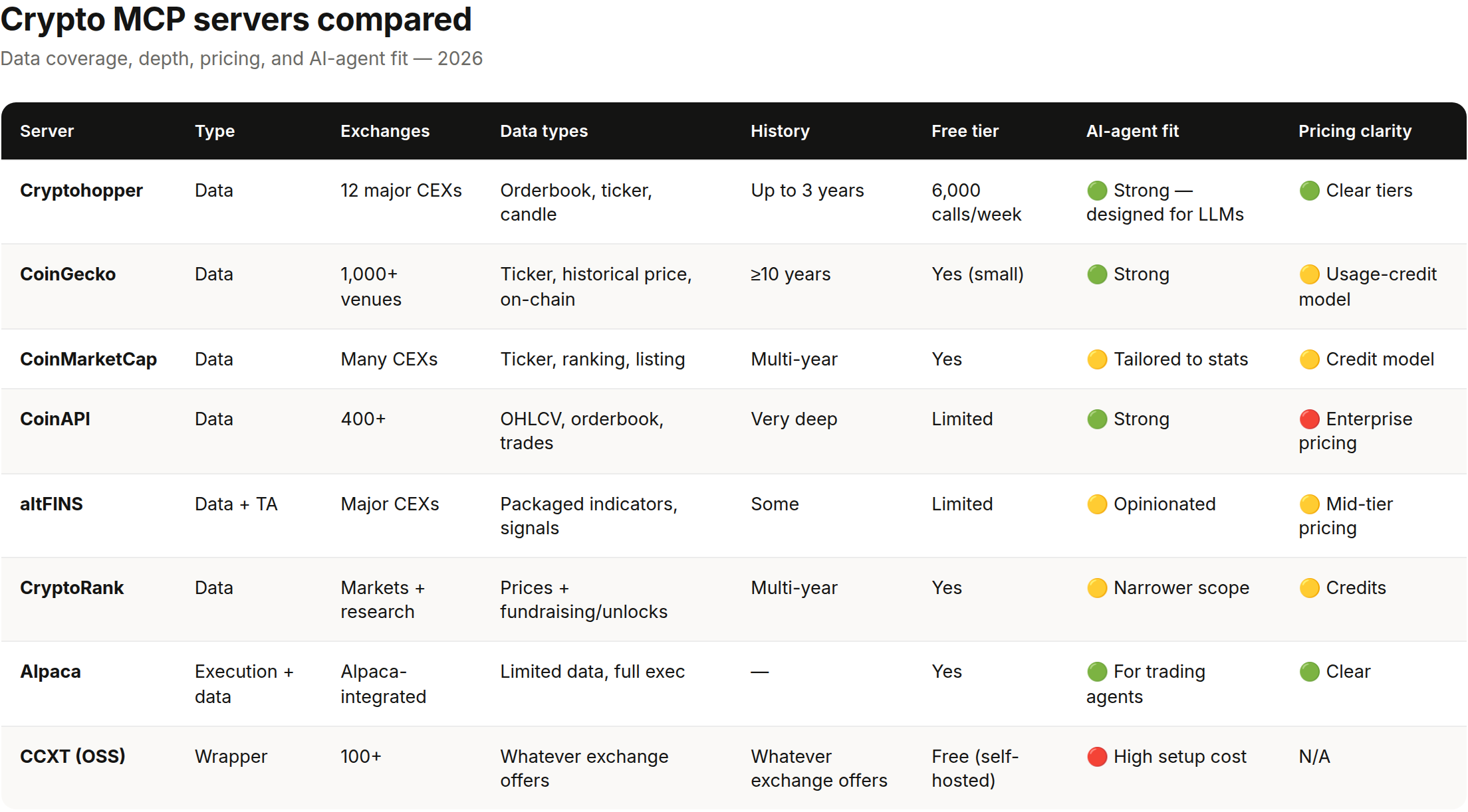
No single row is the winner across every column. The right pick depends on what you're building.
Decision guide — pick the right one for your use case
"I want my AI agent to reason about live crypto markets across multiple exchanges."
Top picks: Cryptohopper, CoinAPI.
Cryptohopper is the closest to a plug-and-play answer for this exact use case — trader-focused data, multi-exchange by design, clean pricing, free tier to try. CoinAPI gives you more historical depth and more exchanges, at enterprise pricing.
Weakness: Cryptohopper covers fewer venues than CCXT or CoinGecko. If you need a specific small-cap or regional exchange, check the supported exchanges list first.
"I want broad coin coverage, especially long-tail altcoins and DeFi tokens."
Top pick: CoinGecko. 1,000+ venues and a huge list of tracked coins, including very small caps and on-chain pools. Cryptohopper does not compete here — we're focused on active trading venues, not long-tail coverage.
"I want pre-computed technical analysis signals — not raw data."
Top pick: altFINS. They've packaged indicators and signals specifically for LLM consumption.
Where Cryptohopper differs: we give you raw candles, and the agent computes indicators itself. This is slightly more verbose but massively more flexible — you don't have to trust our choice of indicator settings, and you can run multi-timeframe workflows without limits.
"I want research data — upcoming unlocks, fundraising, calendar events."
Top pick: CryptoRank, supplemented by CoinGecko for market data.
This is another area where Cryptohopper's MCP doesn't compete today, and probably shouldn't — it's adjacent to trading, not core to it.
"I want my agent to actually place trades."
Top picks today: Alpaca (if US brokerage is acceptable), exchange-specific community MCPs (with caveats), or Cryptohopper's REST API for execution while using Cryptohopper's MCP for data.
What's coming: a dedicated Cryptohopper trade-execution MCP is on our roadmap. When it ships, the data + execution split will collapse into a single stack. For now, the hybrid approach is the honest answer.
"I want one MCP that works across every exchange under the sun."
Top pick: CCXT-based servers. You bring your own per-exchange keys, you deal with per-exchange quirks, but you get coverage nothing else matches.
Where Cryptohopper differs: we aggregate multi-exchange data in one place with a single API key. Fewer venues, no per-exchange setup, no quirks to normalise. Tradeoff.
"I want the cheapest way to get started."
Top pick: Cryptohopper's free Pioneer tier or CoinGecko's free tier.
Cryptohopper Pioneer: 6,000 calls/week, three major exchanges (Binance, Coinbase, Kraken), real-time data only. Enough to build, test, and ship several real workflows before you need to pay anything.
Where Cryptohopper is strongest
We're not an objective party here, but there are a few things we think we're genuinely best-in-class at:
1. Trader-focused multi-exchange data. If your question is "what's the best venue for this trade right now?", Cryptohopper's aggregated orderbook and ticker data is the shortest path to an answer. CoinGecko is broader but shallower; CoinAPI is deeper but pricier.
2. Honest separation of data and execution. A lot of MCPs muddle the line. We're explicit: data MCP now, execution MCP on the roadmap, Trading API for execution in the interim. That's a feature, not a bug — it keeps the responsibilities clean.
3. The Cryptohopper ecosystem. We've been running a bot platform for years. The MCP plugs into your existing account, your existing exchange keys, and your existing grid bots / DCA bots / trailing logic. Compare that to Alpaca, where you need to use their brokerage, or CCXT where you're assembling the plane in mid-air.
4. Clear, simple pricing. Four tiers, flat weekly quotas, no surprise credit burns, and a free tier that's actually usable. Compare to credit-model MCPs where estimating cost is an exercise in patience.
Where the competition is strongest
Equally honest:
CoinGecko's coin coverage. Anything beyond the top ~300 tokens, CoinGecko wins. If you're researching a brand-new listing or a long-tail DeFi pool, check them first.
CoinAPI's historical depth. We offer up to 3 years of history on the Hero tier. CoinAPI goes back further, at higher cost.
altFINS's pre-packaged indicators. If you don't want your agent computing RSI and MACD itself, altFINS is the faster road.
CCXT's universe. If you need an exchange nobody else supports, CCXT is the only game in town.
Alpaca's execution. For the specific use case of "let an agent place actual orders today, MCP-native", Alpaca (and execution-first community servers) beat Cryptohopper today. This gap closes when our trade-execution MCP ships.
How to pick, practically
A short decision tree:
- Do you need execution now, MCP-native? → Alpaca or a reliable exchange-specific MCP. (Revisit Cryptohopper when our execution MCP ships.)
- Do you need coverage of long-tail tokens? → CoinGecko or CCXT.
- Do you need pre-computed indicators? → altFINS.
- Everything else — live multi-exchange market data for active traders, with the option to wire in Cryptohopper bots downstream? → Cryptohopper.
If you're still uncertain, use two MCPs. They compose cleanly — the agent can fetch a ticker from one and pull historical candles from another in the same conversation. Most serious AI-crypto setups end up running at least two MCPs in parallel.
What to watch over the next year
The MCP landscape is still young enough that a 2026 review will look very different from a 2027 review. Three things to keep an eye on:
- Trade-execution MCPs going mainstream. Right now, data is the default. By the end of 2026, execution-capable MCPs will be the default for trading agents, Cryptohopper included.
- Stacking MCPs. Tools like the Claude desktop app already let you run multiple MCP servers at once. Agents that pull market data from one, on-chain data from another, and news from a third will be the norm.
- Real ecosystems beating lone servers. Standalone MCPs without a surrounding product will struggle. MCPs attached to a real platform — Cryptohopper, Alpaca, Hummingbot — will win, because users want the loop to close, not just a data feed.
One last thing
The best way to pick is to try. Every MCP on this list has a free tier or a trial. Hook up two or three in Claude Code or the Claude desktop app, ask each of them the same five questions, and see which one feels right for your workflows.
If you want to start with Cryptohopper, our complete setup guide gets you connected in under ten minutes.


_webp.webp&w=1920&q=75)
_webp.webp&w=1920&q=75)