.webp&w=1920&q=75)
The second you look at the Cryptohopper Market Data MCP, a reasonable question pops up: "Don't I already have this with the REST API?"
It's a fair question. Cryptohopper has offered a REST API for years. MCP does not replace it, and in a lot of setups you'll end up using both. But they are built for very different jobs, and picking the right one for the task you have saves you a surprising amount of time.
This article is a side-by-side comparison. By the end you'll know exactly when to reach for MCP, when to reach for REST, and what a hybrid setup looks like.
What each one is in one sentence
REST API. A traditional HTTP interface where your code decides what to request and when, then does whatever it wants with the response.
MCP (Model Context Protocol). A standardised interface designed so an AI model can discover available tools, decide for itself which to call, and use the result directly in a conversation.
The REST API assumes the caller is a programmer. MCP assumes the caller is an agent that was told, in plain English, to figure something out.
That single distinction is the origin of every other difference between them.
Side-by-side comparison
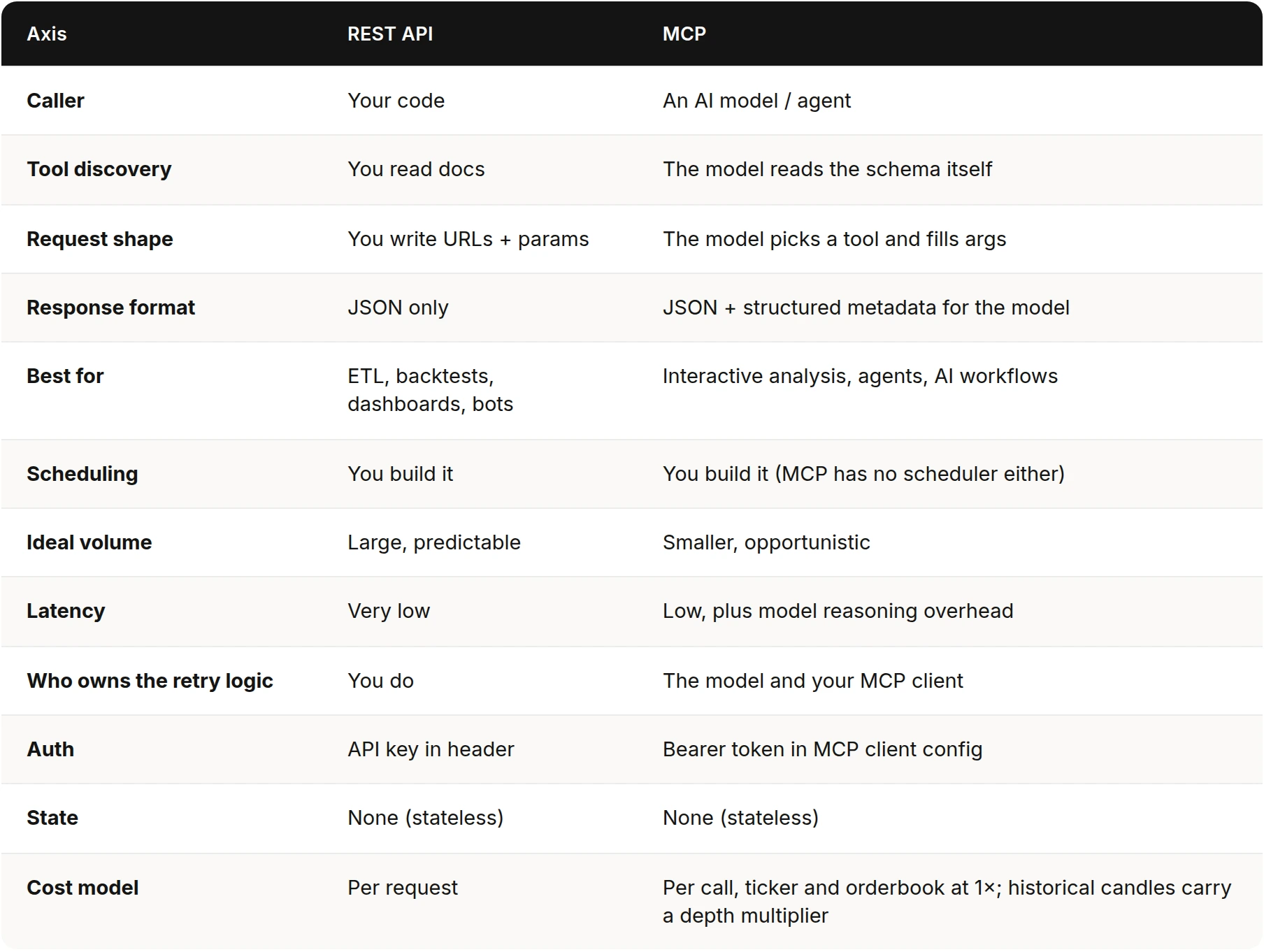
Both are stateless. Both use a bearer token. The actual endpoints exposed overlap significantly. The big difference is how they're invoked — and therefore, what the natural way to build on top of each feels like.
When REST wins
Reach for the REST API when you know, ahead of time, exactly what data you want and in what shape.
Bulk / ETL jobs. You want to download every 1-minute candle for every pair on Binance for a month, dump it into a Postgres database, and run nightly backtests. This is REST's home turf. No AI in the loop, no natural-language uncertainty, just a clean for pair in pairs: get_candles() loop running as fast as rate limits allow.
Production trading bots. A grid bot doesn't need to ask Claude anything. It knows it wants the current price, it wants it every N seconds, and it wants the response shape to be identical every single time. REST's stability and predictability is what bots need.
Dashboards. A React app that renders a real-time price grid doesn't benefit from a reasoning layer. It wants data, cleanly and consistently.
Deterministic reports. Monthly performance reports, regulatory snapshots, tax exports — anything where "the exact same inputs must produce the exact same output forever" is the requirement. Deterministic.
Anything latency-critical. Every MCP call still has the same network cost as REST, but if an AI model is in the loop, the model's reasoning adds measurable overhead (usually a few seconds per tool call). For a human staring at the result, that's nothing. For a bot reacting to a price move in real time, it's unacceptable.
When MCP wins
Reach for MCP when you don't want to hard-code a workflow, and instead want to let an agent figure out the workflow itself.
Interactive analysis. You open Claude Code and type "Run a TA on SOL, compare to ETH, and tell me if there's any relative-strength divergence." Writing the REST code for that would take half an hour. Writing the prompt takes six seconds. MCP is purpose-built for this mode.
AI agents and chat-first tools. If the end user is sending the agent instructions in English, the agent needs some way to go from English → market data → answer. That's MCP. REST simply doesn't fit the shape of the problem.
Exploration and prototyping. Trying out an idea, poking at new data, seeing what shakes out — all of it is faster in a conversational loop. Swap to REST once you know what you want.
Workflows where the shape of the next step depends on the result of the previous step. "If volume is above X, pull the orderbook. Otherwise, pull 4h candles. If the 4h is trending, compare across exchanges." That branching logic lives naturally in an agent driving an MCP. In REST it becomes a mountain of if-statements.
Anything mixed-data. The MCP returns results in a shape the model can immediately reason about together with other things — news, your notes, last week's trades. REST gives you JSON; the glue to the LLM is on you.
A concrete side-by-side: the same task, both ways
Let's pick a simple task and write both versions. Task: get the current BTC/USDT price on Binance.
REST version (pseudo-Python)
import requests

resp = requests.get(
    "https://api.cryptohopper.com/v1/ticker",
    params={"exchange": "binance", "pair": "BTC/USDT"},
    headers={"Authorization": "Bearer YOUR_KEY"},
)
data = resp.json()
print(data["last"])
Works. Takes 15 lines once you add error handling. Scales beautifully to a loop. Nobody needs to explain what happened, because you wrote every line of it.
MCP version (inside Claude Code)
"What's the current BTC/USDT price on Binance?"
That's it. The model picks get_ticker, fills in the args, calls it, and replies in plain English. But — and this is the point — it also works just as well if you ask "Which of Binance, Kraken, and Coinbase has the tightest spread on BTC right now?" The model writes its own little loop. No extra code on your side.
For a single price fetch, REST is trivially simpler. For anything the shape of that second question, MCP is trivially simpler.
The hybrid pattern — use both
Most serious users end up using both, and the reasoning matters because it reveals something about how these tools actually fit together.
The usual architecture:
- MCP for the thinking. The agent researches, scans, analyses, and decides.
- REST for the doing. Once the agent has decided, your code places the order, writes the record, triggers the alert.
The cleanness of the separation is not a workaround for MCP not having execution today. It's a legitimately better way to structure the system: the model is good at reasoning, your code is good at determinism. Don't mix them where you don't have to.
The same applies for research workflows. An agent might use MCP interactively to explore an idea, then write a REST-based script that runs the final version every day on schedule. The MCP session produces the script; the script runs unattended.
What MCP is not better at
It's worth being blunt: MCP has overhead.
- Every tool call is a round trip through the model's reasoning, which costs a bit of time and a bit of model spend.
- The model can make mistakes about which tool to call, or how.
- You are trading some determinism for a lot of flexibility.
None of that matters for research, prototyping, or interactive use. All of it matters for bots that need to do exactly the same thing, reliably, millions of times. Use the right tool for the job.
The Cryptohopper-specific take
Because Cryptohopper runs both a Market Data MCP and a full REST API (and soon a trade-execution MCP), you don't have to pick one forever. You can — and probably should — use both in a layered way:
- Scan and explore in MCP from your IDE or chat client.
- Ship the winning workflow as a small REST-backed script that runs on a schedule.
- For AI agents that trade, use MCP for data and REST for execution today. When the trade-execution MCP ships, the execution layer can migrate too — without rewriting your research.
The short version: MCP is how you think, REST is how you do. Build systems that respect that difference and both tools earn their keep.


_webp.webp&w=1920&q=75)
_webp.webp&w=1920&q=75)