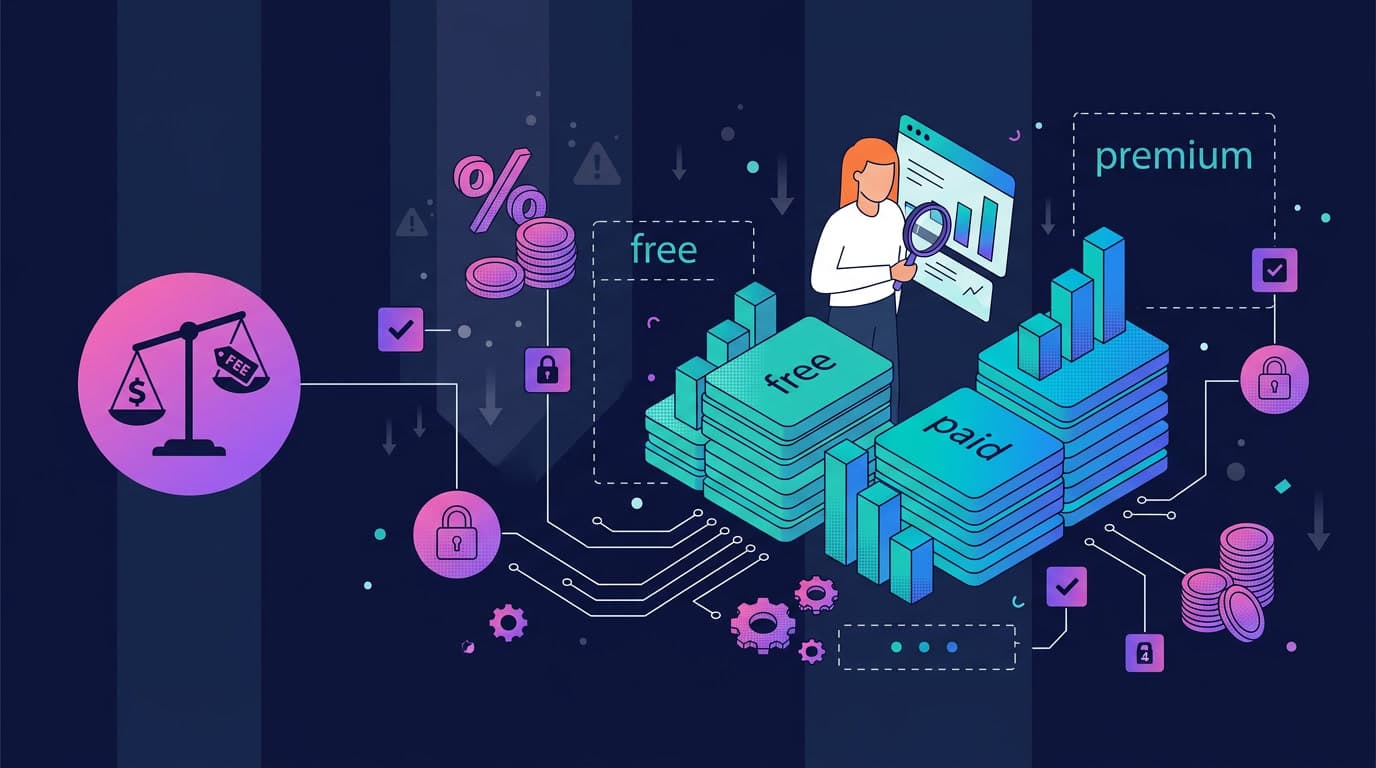
"Free crypto trading bot" means four different things. Three of them cost money. We separated the permanently-free tier, the profit-share, open-source self-hosted code, and the time-limited trial. Now you know what "free" buys.
A note on where this comes from: this article is published by Cryptohopper and links to our own product alongside independent examples. We've tried to keep the comparison honest; judge it on its merits.
The four kinds of "free" - and why the label hides the price
When you type "free bot" into a search bar, you'll encounter various offerings. This single term covers four distinct models, only one of which matches the common understanding of "free."
The permanently-free tier costs nothing in dollars but caps your features: fewer bots, fewer indicators, limited positions. You pay in ceilings, not cash.
The profit-share model is free upfront, then takes a cut of your gains. Freebot.tech markets a bot with a "pay only on profit" fee structure (vendor's own wording, not an endorsement, and not a guarantee that the bot will be profitable; confirm the exact terms and percentage on the live site). Free to start, it's not free to use over time.
The open-source / self-hosted route provides the code for nothing. You still incur costs for server hosting, maintenance, and the significant time investment required to manage it.
The time-limited free trial offers the full product for a set period - commonly about a week to a month - before requiring a subscription. It's a paid product wearing a free costume.
Free software never means free trading. Exchange fees, slippage, and a funded account apply regardless of the bot model you choose. A zero-dollar bot connected to a $2,000 account still incurs taker fees on every filled order.
Directories make this worse. Some listings blur "free trial" and "free" into the same category, and an app or cBot store may label something "free" without mentioning the funded account behind it. This conflation is a significant trap for new users.
Only one of the four "free" bot models is free in the plain sense, and even that one charges you in capped features instead of dollars.
If you arrived expecting a free bot to be a money printer, first read about the myths that cost beginners real cash. We'll wait.
Comparison table: what each free model really costs
Side by side, the four models reveal that the cheapest option to start is rarely the cheapest to maintain. A single-product landing page won't highlight this distinction. The breakdown below is our own analytical framework, based on our comparison of typical vendor offerings rather than any single vendor's published data.
Permanently-free tier
- Upfront cost: $0
- Real long-term cost: low, unless you outgrow the caps
- Feature ceiling: hard limits on bots, indicators, positions
- Support: community-level, which can be slower
- Custody of funds: funds stay on your exchange via API
- Setup difficulty: low
Profit-share
- Upfront cost: $0
- Real long-term cost: rises directly with your gains
- Feature ceiling: usually generous to encourage continued trading
- Support: varies by vendor
- Custody of funds: typically API-connected, funds on exchange
- Setup difficulty: low to medium
Open-source / self-hosted
- Upfront cost: $0 for the code
- Real long-term cost: hosting expenses plus your time, which is a significant factor
- Feature ceiling: unlimited if you have the skills to build it
- Support: relies on GitHub issues and forums - you are your own help desk
- Custody of funds: best, as nothing touches a third party
- Setup difficulty: high; expect to work with terminals and config files
Time-limited trial
- Upfront cost: $0 for the trial period
- Real long-term cost: full subscription price once the trial ends
- Feature ceiling: none during the trial
- Support: full product support while the trial is active
- Custody of funds: API-connected, funds on exchange
- Setup difficulty: low to medium
Remember the unlisted costs: funded account + exchange fees + slippage. These apply to all four models, whichever "free" option you choose.
Profit-share bots cost nothing to start, yet they're the only model whose price climbs the better you trade.
To see where any limited tier ends and paid features begin, consult the feature overview. If you'd rather triangulate, platforms such as 3Commas, Pionex, Bitsgap, Shrimpy, and HaasOnline publish their own tier structures worth comparing side by side.
Who each free model is actually for
The most cost-effective bot for a beginner is rarely the same as for an active trader. Match the model to your needs rather than chasing the lowest sticker price.
If you are an absolute beginner, a free tier combined with paper trading is your ideal starting point. This lets you learn the mechanics before committing any real capital. Avoid self-hosting, as you'll likely spend your first month debugging a server instead of understanding trading principles.
For strategy testers, a free trial with full features, coupled with paper trading, lets you stress-test a setup - and avoids paying for a year before you're committed.
If you are a developer, the open-source self-hosted option is a natural fit. You want control and can read the code. The "cost" here is primarily time, which you would likely spend anyway.
For a cost-sensitive active trader, the math matters most. Compare the profit-share cut against a flat paid plan - a cost comparison exercise, not a recommendation of either pricing model, since the better choice depends on your own trading volume and results, which are not guaranteed. For illustration only: say a vendor charges 20% - a 20% cut on $5,000 of hypothetical monthly gains would amount to $1,000, which can exceed a fixed subscription. Actual profit-share structures differ widely; the percentage varies by vendor, and some charge only on realized or withdrawn profit while others use high-water marks to avoid double-charging on gains you give back. Profit-share models are structured so the vendor earns more precisely when the trader's gains are larger.
For a broader view of where a free bot fits, the breakdown of the three real paths to automate trading covers the full landscape.
What's the catch? The custody and API-key question
The primary concern across all four models isn't the price, but what the bot can do with your account. This hinges on your API key permissions.
A bot connects to your exchange using an API key, which grants specific permissions. As a matter of standard exchange API security practice, well-configured setups keep your funds on your exchange rather than taking custody of them. Freebot.tech, for instance, highlights "keep your funds in your own account" - vendor marketing, not a safety guarantee from us; real protection comes only from the API key permissions described below.
Actual protection comes from mechanical configurations, not promotional claims. Grant trade-only permissions, disable withdrawals on the key, and, where your exchange supports it, add IP whitelisting so only your bot's server can use it.
But don't treat these three settings as a complete solution. Not all retail exchanges support granular per-key IP whitelisting. A trade-only key can still be abused - for example, to churn your balance into illiquid or manipulated pairs - and some strategies (such as futures bots that manage positions) legitimately need broader scopes than "trade-only" to function. Vendor-side security matters as much as your own settings: wherever your key and secret are stored, a server compromise or key leak on the vendor's end is a real exposure that your permission choices alone cannot fully close.
A bot connected with a withdrawal-disabled API key can trade your account but can't withdraw from it - one setting that narrows, though does not eliminate, your exposure.
Configure the key carefully and understand its limits, and the "what's the catch" question shifts from a pure trust issue toward a more controllable permissions issue.
The genuinely free, zero-risk path: paper trading
There is one "free bot" that genuinely costs nothing and carries no risk: paper trading. The money involved isn't real. Yet many pages ranking for "free bot" overlook it entirely.
Paper trading executes your strategy against live prices using simulated funds. You can watch dollar-cost averaging (DCA) mechanics, which buy fixed amounts on a schedule, or a grid strategy, which places staggered orders across a price range. These are mechanical descriptions only - neither DCA nor grid strategies guarantee profit, and outcomes depend entirely on market conditions. You learn how the bot behaves without risking any capital.
Websites like the AI Trading Competition let anyone watch bots trade live prices with practice money (confirm the current number of bots and claims on the live site). These bots are ranked by their simulated paper-trading return against the S&P 500 for informational and educational comparison only, accessible for free and without signup. Treat these figures strictly as simulated results - simulated performance does not predict future results.
For a structured approach, the 4-week paper-trading protocol guides you through a deliberate process for going live. Cryptohopper's free/limited tier and trial are one example of a no-upfront-cost way to test a bot's mechanics - not a claim that this or any free tier will be profitable. We do not claim that a fully-featured free bot for sustainable trading exists, because it doesn't.
Counterpoint: "but reviewers say free bots are just worse"
Some commercial reviewers argue that free bots are inferior - though that's their opinion, not an established fact. Trading Bot Experts, for instance, appears to guide readers toward paid solutions. A reviewer who monetizes paid referrals has a vested interest in this perspective. Consider it an opinion, not a verdict.
Think of a free tier like a gym day-pass. It's perfect for learning the equipment, but unsuitable if you're training for a marathon. The issue isn't "free" itself, but using a free option beyond its intended purpose.
Free bots aren't worse - in many cases they're simply purpose-limited; the risk is using one beyond the scope it was built for.
A free tier designed to teach you order types isn't failing when it can't run fifty concurrent strategies. You're simply asking a day-pass to win a marathon. The taxonomy above exists to help you avoid such mismatches.
Practical takeaway: pick your free by your purpose, not the price tag
Begin with paper trading. Match the bot model to your user type, as outlined in the table. Before going live, calculate the combined cost of fees and profit-share.
A percentage cut that seems small on $500 of gains will look significantly larger on $5,000.
No bot, whether free or paid, guarantees a profitable outcome. Profitability depends on your strategy and market conditions. The pricing page clearly delineates where a limited tier ends and paid features begin. For those seeking no-cost tools, the marketplace offers free strategies and signals.
Choose a free bot as you would any free tool for a specific job. The key question is whether it effectively performs the one task you actually need, not simply whether it carries the label "free."
FAQ
If it's "free," how much of my profit do I actually have to pay?
With a permanently-free tier or a trial, you pay nothing beyond exchange fees and slippage. On a profit-share model, you pay a percentage of your gains. The exact cut varies by vendor - and some charge only on realized or withdrawn profit, or apply high-water marks - so always confirm the current terms before connecting. The critical point: a percentage of profit can far exceed a flat subscription once your gains scale. This is why profit-share models earn the vendor more when the trader's gains are larger - and those gains are never guaranteed.
Can I really keep my funds on my own exchange with a free bot?
In most reputable setups, yes. The bot connects through an API key, and your funds stay in your exchange account. Vendors often highlight this in their marketing, but that marketing is not a safety guarantee. As a matter of standard exchange API security practice, the real protection lies in how you configure the key: grant trade-only permissions, disable withdrawals, and enable IP whitelisting where supported. These settings are largely within your control, but not absolute - not every exchange offers per-key IP whitelisting, trade-only keys can still be misused, and vendor-side storage of your key is its own exposure. Weigh all of that regardless of any marketing promises.
What's the difference between a free trial and a truly free bot?
A free trial provides access to the full product for a limited period, typically days or weeks, after which the full subscription fee is charged. A truly free bot, or a permanently-free tier, costs nothing indefinitely but comes with capped features, such as fewer bots, fewer indicators, or limited positions. Directories frequently blur these distinctions, which can lead users to unexpected bills.
This article is for educational purposes only and is not financial or investment advice. Cryptocurrency trading involves substantial risk, including the possible loss of your capital. Do your own research and never trade more than you can afford to lose.

_webp.webp&w=1920&q=75)
_webp.webp&w=1920&q=75)