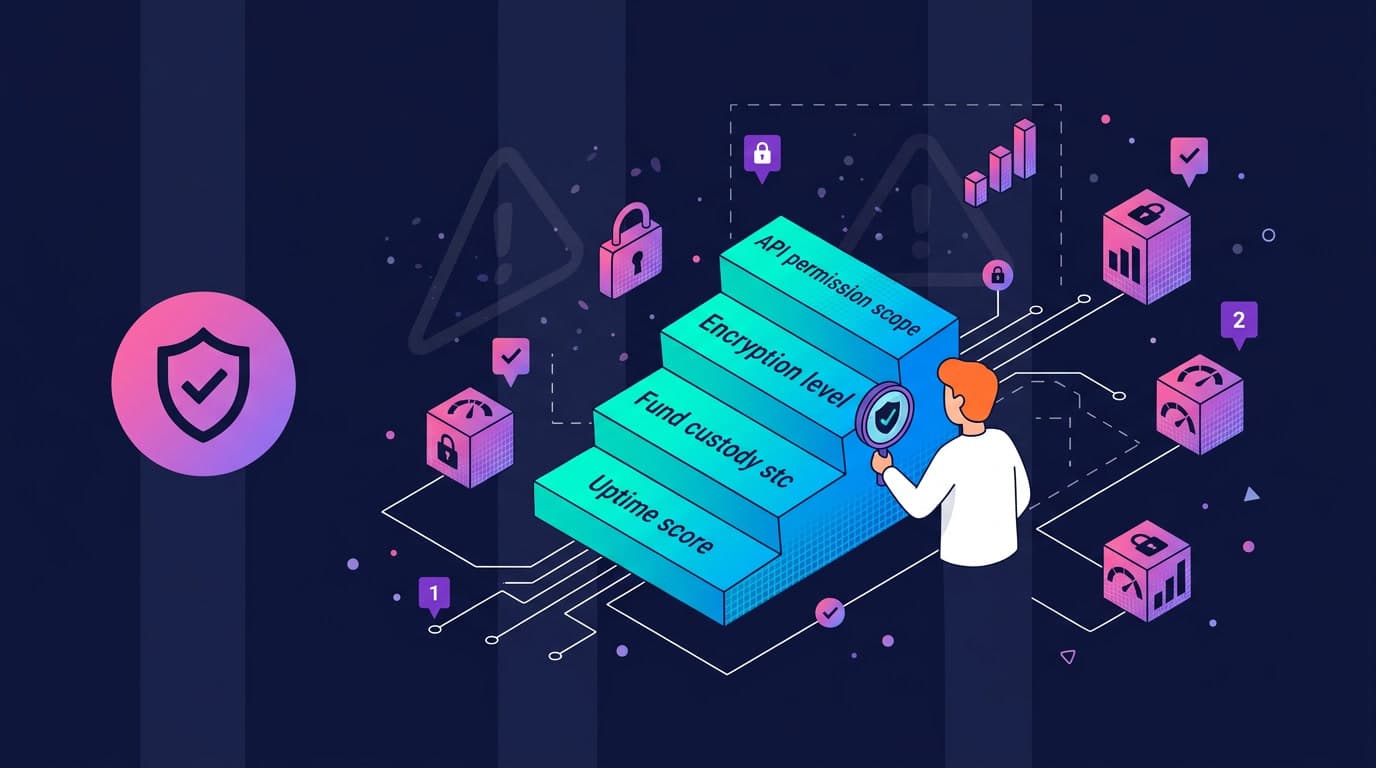
"Safe bot" means four unrelated things online. None of the pages ranking for it serve the person who typed it - a trader asking whether a crypto bot can drain their account. In automated trading, "safe" never means "no loss." It means something you can actually measure.
First, which "safe bot" do you actually mean?
Search "safe bot" and you get a pile-up of four meanings that have nothing to do with each other. One is industrial robotics - a research project on collision avoidance for factory cobots. One is a home-security scoring app. Two are messaging utilities: Discord server moderation and a Telegram/WhatsApp scam filter (no such scam-detection tool can guarantee a message, link, or token is safe). And then there's the one you probably meant. A crypto trading bot.
The term fragments because "bot" is a vast category spanning everything from factory robots to messaging utilities to trading software. When a single word stretches that far, a two-word query can't point at one thing.
"Safe bot" is not one search - it's four, and only one of them is about whether your money is at risk.
So here's the pivot. If you landed here because you're about to connect something to an exchange, this page is for you. Everything below is about crypto trading bots only. The robots and the Discord mods can wait.
What "safe" can and cannot mean in a trading bot
Let's kill the misconception every vendor page tiptoes around: there is no no-loss bot. None. All trading carries risk, and no software removes it. Vendor pages market bots as "low-risk" or "unlimited and free" (e.g., mql5's "Safe Bot" listing, or Telegram bots advertised as "unlimited and FREE"). These are unverified marketing claims by the vendor, not independent or verified ratings - including from us. Treat them accordingly.
We won't pretend otherwise, because the honest version is more useful. "Safe" in a trading bot is a set of measurable properties, not immunity from a red candle. It's whether the API key can move your money. It's whether you can enforce a stop-loss. It's whether you can test on simulated funds first. It's who holds your coins.
A safe trading bot isn't one that can't lose money - it's one that can't do more damage than you authorized.
If you internalize one idea here, make it that. The myth that bots "print money while you sleep" has cost more beginners than any flash crash. We unpack that and four related traps in the myths that cost beginners real cash guide.
The six dimensions that actually determine bot safety
Forget feature lists. Bot safety comes down to six dimensions, and we rated four common archetypes across all of them: cloud/SaaS automation platforms, open-source self-hosted bots, Telegram/signal "copy" bots, and exchange-native grid/DCA bots. These are our qualitative judgments, not empirically verified industry-wide facts. No archetype wins outright - each buys one kind of safety by spending another. Here's the side-by-side, dimension by dimension, with the full comparison grid at the end of this section.
API-key withdrawal permissions
This is the single most important dimension, so read it twice. An API key is the credential a bot uses to trade on your behalf. If that key carries withdrawal permission, a compromised or malicious bot can send your coins off-exchange. If it doesn't, the worst case is bad trades. Painful, but recoverable.
- Cloud/SaaS platforms: generally operate on trade-only keys; good ones support withdrawal-disabled keys and IP whitelisting.
- Open-source self-hosted: you control the key scope entirely - safest if configured right, dangerous if you misconfigure it.
- Telegram/signal copy bots: vary wildly; some request broad permissions, and you often can't inspect why.
- Exchange-native grid/DCA: runs inside the exchange, so there's no external key to leak at all. This removes key-leakage risk but does not reduce market risk or guarantee against loss - no archetype is risk-free.
And "trade-only" is not a full safety guarantee. In the 2022 incident involving 3Commas, reports described large numbers of API keys being leaked and then abused; according to those reports, even keys without withdrawal rights were used to execute pump-and-dump trades on illiquid pairs, draining value through forced trades rather than withdrawals. Disabling withdrawals narrows the blast radius; it does not reduce it to zero.
The safest bot is the one whose API key physically cannot withdraw your funds - every other feature is secondary to that single permission.
Stop-loss and risk controls
A bot without enforced risk limits is a position with no exit plan. Here the dimension is whether stop-loss, trailing stop-loss, and position sizing are built in and reliably triggered. Many cloud/SaaS platforms support stop-loss, trailing stop-loss, paper trading, and API security controls - for example, Cryptohopper's feature set - and these are the features that populate this column (described here for illustration, not as an endorsement of any single product's safety ranking). A raw signal bot in a Telegram channel usually doesn't enforce anything.
Paper-trading availability
Can you run the strategy on simulated money before risking a dollar? Cloud platforms and open-source bots usually offer this. Many copy bots don't - you're expected to go live on trust.
Custody model
Do you keep your coins on your own exchange account, or does the bot pool funds? Trade-only bots that never touch custody are structurally lower-risk than anything that takes possession of capital. But note the limit of that logic: no external key risk doesn't mean no risk - your funds still sit in exchange custody, exposed to exchange insolvency or withdrawal freezes, independent of anything the bot does.
Transparency and auditability
Can you see the code, the track record, the operator's identity? Open-source bots are, in principle, auditable by anyone who reads the code. Signal bots are often the opposite, and users feel it. One secondhand figure - cited by BotPenguin and attributed to Statista, and which should be verified against the original source - puts Telegram users' concern about bot data security at a notable share. In our assessment, that unease is exactly why anonymous signal bots score low here.
Cost
"Free" is never free. Open-source saves subscription fees but costs you server upkeep and configuration skill. SaaS charges a fee but handles infrastructure. Copy bots advertised as free often monetize through exchange referral kickbacks tied to your trading volume - check the specific bot's terms to confirm. Understand who's paid, and how.
The six dimensions, archetype by archetype
Here is the whole grid in one place, so you can scan the trade-offs instead of holding six sections in your head. These ratings are our qualitative judgments, not verified industry facts.
- API-key withdrawal permissions: Trade-only, withdrawal-disabled keys + IP whitelisting on good ones - You set the scope - safest if correct, risky if misconfigured - Varies wildly; some request broad permissions - No external key to leak at all
- Stop-loss & risk controls: Usually built in and enforced - Available, but you configure it - Often none enforced - Rule-based by design; limited custom stops
- Paper-trading availability: Usually offered - Usually offered - Often absent - Varies by exchange
- Custody model: Funds stay in your exchange account - Funds stay in your exchange account - Some pool funds - higher risk - Funds stay inside the exchange
- Transparency & auditability: Partial; closed code, public track record - Fully auditable code - Often anonymous and opaque - Exchange-disclosed mechanics
- Cost: Subscription fee, infrastructure handled - Free software, you pay in upkeep/skill - "Free" often via referral kickbacks - Usually exchange trading fees only
The questions to ask before you trust any bot
Stop asking "is this a scam?" It's the wrong question. Ask instead: what can this thing do to my account the day it breaks or gets compromised? That's blast-radius thinking, and it's platform-agnostic.
Run through five questions before you connect anything. Does it require withdrawal permissions on the API key? Can you enable IP whitelisting so only your server can use the key? Are the advertised results from live trading or just backtests? What's the configured or historical maximum drawdown - the deepest peak-to-trough loss? And is custody yours or theirs?
Before asking if a bot is profitable, ask what it can do to your account the day it breaks - that answer is the real safety rating.
The concrete steps for locking down a key live in our API-key hardening guide. Read it before, not after.
The counterargument: "If I set a stop-loss, I'm safe, right?"
Half true, and the dangerous half is the one people skip. A stop-loss is a seatbelt, not a force field. It limits damage in a predictable crash. It does not protect you in every accident.
Here's the mechanism. A stop-loss triggers a sell when price hits your level. But in a fast gap-down, the next available price can be far below that level. That's slippage. In a flash crash or an illiquid pair, your order fills well under your stop. On leverage, it triggers liquidation before it ever sells. The seatbelt was fastened. The gap jumped right past it.
A stop-loss is a seatbelt, not a force field - it limits damage in a normal crash, but a fast enough gap can jump right past it.
So treat a stop-loss as risk mitigation, not a guarantee: it limits damage in typical price declines, but outcomes vary by market conditions. If you want it to survive turbulence, see how to set a stop-loss that survives volatility and the broader risk management in unstable markets guide.
Who each bot type is for
The right archetype depends on who you are, so segment honestly. Three profiles, three different priorities on that six-dimension grid.
If you're a first-timer, the safest configuration isn't a better bot. It's paper trading with nothing live connected. Your priority dimension is paper-trading availability. Connect no real funds yet. Full stop.
If you've never run a bot, the safest configuration isn't a better bot - it's paper trading with zero real money connected.
If you're a risk-averse DCA user who wants slow, rules-based accumulation, your priority is the custody model and a withdrawal-disabled key. Exchange-native DCA and trade-only cloud platforms fit the temperament. Transparency matters more to you than speed.
If you're an active trader watching the charts all day, your priority is enforced stop-loss and trailing-stop discipline. You need risk controls that fire without you watching. That's where built-in risk toolkits earn their keep over a bare signal feed.
Practical next steps: start with the lowest-risk setup
Don't go shopping for the perfect bot. Build the lowest-risk setup first and prove it, in this order.
Paper-trade a strategy before anything touches real money. The four-week paper-trading protocol walks through it. Then create a withdrawal-disabled API key with IP whitelisting, per the hardening guide. Configure a stop-loss sized to a drawdown you can actually tolerate. And size every position to a loss you can absorb without flinching.
The safest way to start isn't choosing the perfect bot - it's proving a strategy on simulated money before a single dollar is at risk.
Every one of those steps shrinks your blast radius. None of them removes risk. Keep both halves of that sentence in view the day you flip the switch to live.
FAQ
What does "safe bot" even mean - is there such a thing as a no-loss crypto bot?
No. There is no crypto bot that eliminates loss, and any product implying otherwise is making an unverified marketing claim. "Safe" in automated trading describes measurable risk-management properties. Limited API permissions, enforced stop-loss, paper trading, transparent custody - not immunity from losing money. All trading carries risk. Software changes how much damage is possible, not whether loss is possible.
Do I have to give the bot my API keys with withdrawal permissions?
Generally, no - and you usually shouldn't. A trading bot needs permission to place trades, not to move funds off the exchange. Create a withdrawal-disabled key, ideally with IP whitelisting so only your server can use it. Then even a compromised bot can't send your coins elsewhere. Note that trade-only keys still carry residual risk - leaked keys have reportedly been abused to force trades on illiquid pairs - so the worst case shrinks toward bad trades rather than an emptied account, but doesn't vanish. Confirm your exchange supports granular key permissions before connecting anything.
What's the safest way to test a bot before risking real money?
Paper trading - running a strategy with simulated funds that mirror live market conditions but risk zero real capital. It lets you see how a configuration behaves across ordinary moves and sharp drops before a single dollar is exposed. Our four-week paper-trading protocol outlines a structured way to do this. It's the single most risk-reducing step a first-timer can take.
Methodology: This comparison rates bot archetypes qualitatively across six risk dimensions; it does not rank or endorse any named product, and no original market data was produced for this article. The Telegram user-concern figure is secondhand (cited by BotPenguin, attributed to Statista) and should be verified against the original source; internal links should be confirmed live before publishing.
This article is for educational purposes only and is not financial or investment advice. Cryptocurrency trading involves substantial risk, including the possible loss of your capital. Do your own research and never trade more than you can afford to lose.

_webp.webp&w=1920&q=75)
_webp.webp&w=1920&q=75)