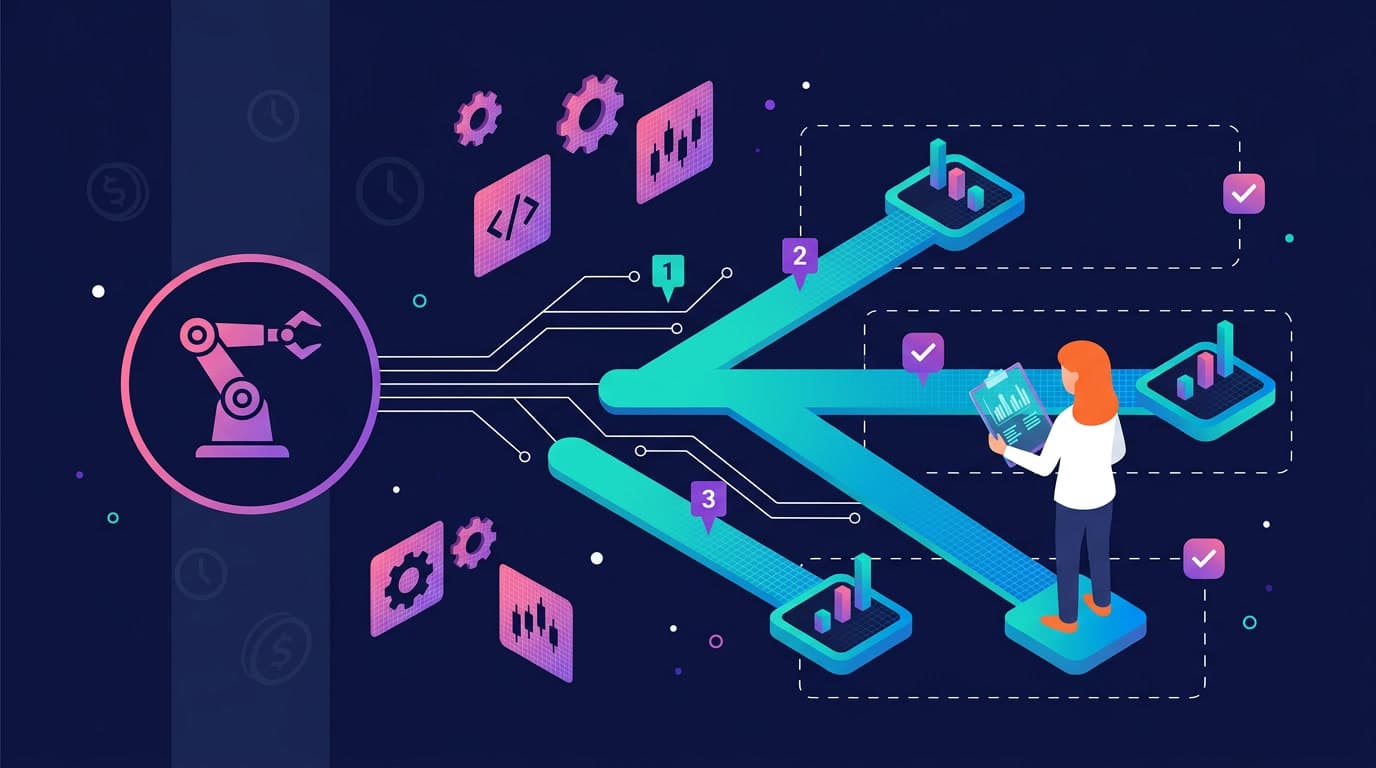
There are only three real ways to automate trading. A no-code bot platform, a TradingView-to-broker webhook relay, or a custom-coded bot in Python or MQL. This compares all three - cost, skill, setup, and what breaks.
First, how much of the market is already automated?
You're not deciding whether to join a machine-run market. You already trade inside one. Automated systems execute roughly 70% of U.S. equity trades and 60-75% of global equity volume, according to The Paper Trading Journal's figures - a third-party estimate rather than an independently confirmed regulator count.
Forex and futures tell the same story. Around 58% of forex trades run on automated systems, and more than half of all futures transactions are machine-executed, according to the same Paper Trading Journal figures.
So let's kill the framing every vendor page uses. Automated systems already dominate equity markets. The comparison below tells you which mechanics fit your situation, not that you must automate. The retail question, if you do, is which path you join on.
That's the question the whole search result page ducks. We'll answer it.
The three real paths to automating a trade
Strip the marketing away and every automated setup collapses into one of three categories. An automated trading system is just a program that generates orders from rules you set. The difference is who builds the rules and who runs them.
Path 1 - The no-code bot platform
You configure a strategy in a visual builder, lean on templates like DCA or grid, and let the platform execute. Cryptohopper and 3Commas are examples of this category. Our head-to-head comparison of the two shows how much these platforms overlap and where they diverge.
Path 2 - The TradingView/webhook relay
You chart and build alerts in TradingView. Then a relay forwards the webhook - a one-way automated message - to a broker's API to place the order. PickMyTrade and TradersPost are examples here. You keep your charts; the relay handles execution.
Path 3 - Custom-coded in Python or MQL
You write the logic yourself. MetaTrader's Expert Advisors and Python libraries are the common tools. Maximum control. Every bug is yours to own.
That's the whole map. Every automated setup, no matter how it's marketed, is one of three things. A no-code platform you configure, a relay that passes your TradingView alerts to a broker, or code you write and maintain yourself.
Side-by-side: the three paths compared
No column produces a clean winner. Each path trades one constraint for another. So read this as what you're giving up, not what you're getting.
No-code bot platform
- Cost: low-to-moderate monthly subscription, little-to-no cash upfront
- Skill required: low - visual builder, templates, built-in backtesting
- Setup time: fast, often same-day
- Flexibility: moderate - you work within the platform's features
- Primary failure mode: boxed into the platform's feature set and template assumptions; your edge is capped by what the tool allows
TradingView/webhook relay
- Cost: low - TradingView plan plus a relay fee
- Skill required: moderate - you wire alerts, webhooks, and broker API keys
- Setup time: medium
- Flexibility: high on strategy design, tied to TradingView's alert engine
- Primary failure mode: silent webhook or API drops, missed or duplicated orders, latency between signal and fill
Custom-coded (Python/MQL)
- Cost: low cash, high time - your weekends are the price
- Skill required: high - you code, test, and debug everything
- Setup time: slow
- Flexibility: maximum - anything you can express, you can run
- Primary failure mode: your own bugs, infrastructure downtime, and an endless maintenance burden
There is no best path, only a best fit. The no-code platform trades flexibility for speed. The webhook relay trades reliability for control, and custom code trades your weekends for total freedom.
What the numbers say about whether it actually works
We won't pretend automation prints money. The reported numbers are more interesting than that - but treat them with real caution, because the sources below are third-party write-ups, not peer-reviewed studies or regulator disclosures. TradingView Hub's report states that around 60% of retail algo traders showed positive annual returns versus 5-10% of manual day traders. That figure runs sharply against well-established academic research - UC Berkeley's Barber and Odean work and regulator data from markets like Taiwan and Brazil consistently find the large majority of retail day traders lose money over time - so take the 60% claim as an unverified outlier, likely flattered by survivorship bias and unclear sampling.
A separate analysis attributed to CoinGecko covering 12,000 automated signal traders, cited by LedgerMind, reported a median annual return of 23% with 52% win rates. CoinGecko is best known as a price-data aggregator rather than a publisher of trader-performance research, so treat these figures as illustrative at best. Past performance does not guarantee future results.
Here's the part the headlines skip. In that same LedgerMind-cited analysis, the top 10% reportedly returned 67% while the bottom 10% lost 31%. That dispersion, if real, is the whole story. And note the trap in the 52% win rate: win rate alone tells you nothing about profitability. Two strategies with identical win rates can have opposite expectancy, because profit is decided by average win size versus average loss size, not by how often you're right. Automation doesn't decide the outcome. It just executes the strategy behind it.
So the spread, not the median, is what matters. The path and strategy you choose decide which end of that distribution you're exposed to. Automation itself is neutral.
The cruise-control analogy: why 'set and forget' is the expensive myth
Automated trading is cruise control, not a self-driving car. It holds the speed you set, but you still steer, brake, and watch the road. The moment the road changes, a system left unwatched drives you straight into strategy decay.
Proponents such as OANDA frame automation as reducing emotional trading decisions. What it actually does is swap emotional stress for operational stress. Now you're minding API uptime and watching for a strategy that quietly stopped working.
Three things reliably go wrong. Strategies decay as markets shift and the edge that backtested beautifully evaporates. Over-optimization and look-ahead bias make a backtest look like genius and live trading look like a coin flip. And technical failures - API downtime, dropped webhooks - hit when you least expect them.
That's why the responsible step before any live capital is a structured paper-trading protocol. If you've absorbed vendor promises, our breakdown of the 'bots print money while you sleep' myth is worth a read first.
Who each path is for
Match the path to your weakest resource. Short on skill, no-code is the easiest entry. Short on time, signals may fit. Short on nothing but patience, writing the code yourself is on the table.
The beginner will find a no-code bot platform easiest to start with. Templates and built-in backtesting lower the entry bar. Tools like Cryptohopper's DCA, grid, and strategy-builder features (one example among several no-code platforms) let you configure a rules-based system without touching code; this is not an endorsement, and automated trading carries risk of loss regardless of platform.
The TradingView chartist will find the webhook relay a natural fit. You already live in your charts and indicators. A relay just adds execution to what you've built.
The developer will prefer the custom-coded path. You want full control and can actually fix it when something breaks at 3am.
The signal-follower with no time to build has a fourth option within the no-code category. A marketplace of pre-built strategies or copy-trading, like the Cryptohopper Marketplace (cited as one example of this category) - copying another trader's strategy does not guarantee similar results and carries the same risk of loss as any other automated path. Okay, that's slightly oversimplified. Copy-trading is really its own lane that happens to live under the no-code roof. If you're torn between following and building, our breakdown of copy-trading versus bot-building maps it to where you are now. The deeper how-to for all three lives in our three-paths pillar guide.
Your next move
Pick based on your scarcest resource - cash, skill, or time. Not on which vendor had the loudest landing page. Then take one concrete action. Open a no-code builder and load a template, wire a single TradingView alert to a relay, or draft one strategy in code.
Automated trading carries real risk of loss regardless of path. Whichever one you pick, the first live trade should never be the first time you've run the system. Paper-trade it first. The cheapest failure is the one that costs nothing.
FAQ
Has anyone ever actually run auto-trading successfully, or is it just hype?
Reported findings suggest some do, but the numbers deserve skepticism. TradingView Hub states around 60% of retail algo traders showed positive annual returns (per its report), and an analysis attributed to CoinGecko of 12,000 signal traders reported a 23% median return (primary study not independently verified). Both figures run against decades of academic research showing most retail traders lose money, and the same cited analysis showed the bottom decile losing 31%. So success is far from universal, and past performance does not guarantee future results.
Can I automate trading without knowing how to code?
Yes. That's the entire premise of the no-code bot platform and the webhook relay paths. No-code platforms use visual builders and templates. Relays forward your TradingView alerts to a broker without you writing execution logic. Only the custom-coded path requires programming.
What are the real risks of letting a bot trade for me?
Three dominate. Strategy decay as markets shift and your edge fades. Over-optimization and look-ahead bias that flatter a backtest but fail live. And technical failures like API downtime or dropped webhooks. Automation executes your strategy faithfully - including when the strategy is wrong. That's why testing on paper before going live is the non-negotiable step.
Methodology: Market-penetration and profitability figures are cited third-party findings from The Paper Trading Journal, TradingView Hub, and an analysis attributed to CoinGecko via LedgerMind, linked at the point of use. Per internal review, several of these figures - including the ~70% equity-automation share and the CoinGecko 12,000-trader performance data - remain pending independent verification against a primary source; the 60% algo-trader profitability claim in particular conflicts with established academic research and should be treated as unverified. No first-party market data was computed for this piece. Verify all statistics against their original sources before relying on them.
This article is for educational purposes only and is not financial or investment advice. Cryptocurrency trading involves substantial risk, including the possible loss of your capital. Do your own research and never trade more than you can afford to lose.

_webp.webp&w=1920&q=75)
_webp.webp&w=1920&q=75)