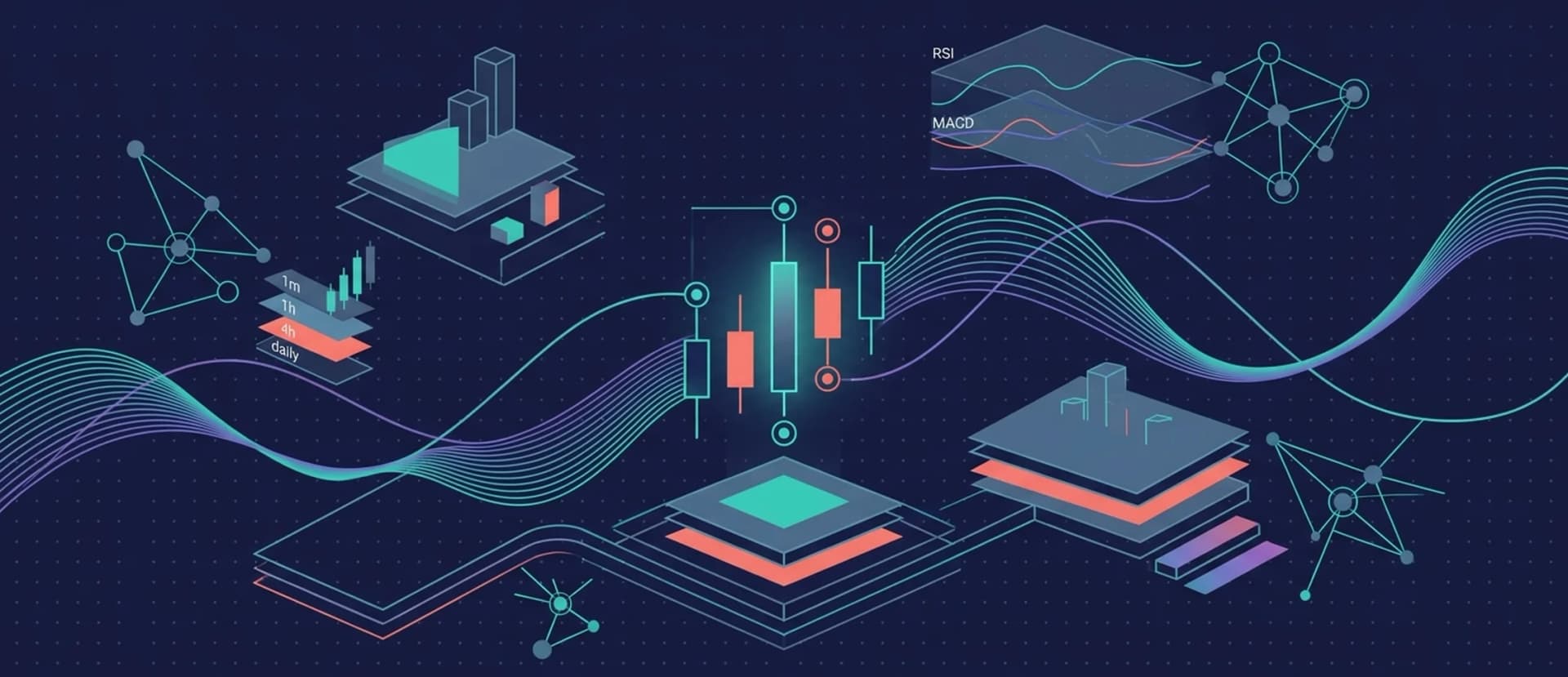
Candles are the oldest piece of trader technology we still use. The Japanese rice market invented them in the 1700s, and pretty much every chart you've ever seen — TradingView, Binance, Cryptohopper, your broker, your exchange — is still drawing them. Every indicator anyone cares about is a function of candle data. Every backtest is a loop over candle data. If you want to reason about the history of a market, rather than just the current state, candles are the only data type that does it.
This article is a practical walkthrough of candle (OHLCV) data: what's inside one, how to pick a timeframe, how indicators fall out, and how to use them cleanly through the Cryptohopper Market Data MCP without torching your weekly quota.
What a candle actually is
Every candle summarises what happened in a fixed time window — one minute, five minutes, one hour, four hours, one day. For that window you get five numbers:
- Open — the first trade price inside the window.
- High — the highest trade during the window.
- Low — the lowest trade.
- Close — the last trade price when the window ended (or the current price if the window is still open).
- Volume — the total amount of the base asset that traded inside the window.
That's OHLCV. Five numbers. A series of them, evenly spaced in time, is what a chart is made of. Everything else is derived from this.
The genius of candles is the compression. A one-hour window on a busy pair might contain tens of thousands of individual trades. OHLCV squeezes that down to five numbers that preserve almost everything a trader actually cares about: where did it start, how high did it go, how low, where did it finish, and how much traded through. The gritty tick-level detail is gone, but the shape is intact.
Picking a timeframe
Timeframe choice is the single most-important decision in any candle-based workflow, and it gets under-thought constantly. A quick mental map:
1-minute and 5-minute candles are noisy. They react to individual large trades, microstructure effects, liquidity holes. Good for execution analysis, short-term scalping, or building intra-day signals. Bad for making trend judgements.
15-minute and 1-hour candles are the workhorse. Most intraday technical analysis lives here. Indicators on 1h candles are responsive enough to matter and smooth enough to trust.
4-hour candles are the swing-trader sweet spot. Long enough to filter noise, short enough to catch multi-day moves. Most grid-bot range-finding and swing-trade analysis uses 4h.
Daily candles are the macro view. Noise is basically gone. Trends, regimes, multi-week ranges, and longer-term backtests all live here.
Weekly and monthly candles are for long-horizon investors. Useful for HODL decisions, long-term cycle analysis. Not useful for anything tactical.
The classic setup for most AI-driven technical analysis is a multi-timeframe read: pull 1h and 4h (and maybe daily), and only trust a signal if it agrees across at least two. One-timeframe analysis fools you often; multi-timeframe analysis fools you less.
Lookback — how far back should you ask?
The second most important decision, and the one that most often burns MCP quota unnecessarily.
A few rules of thumb for common indicators:
- RSI(14) — needs at least 14 candles. 100 is comfortable. 500 is overkill.
- MACD(12, 26, 9) — needs 26 + 9 = 35 candles minimum for the signal line to be meaningful. 100 gives you plenty of context.
- Moving averages (20, 50, 200) — you need at least as many candles as your slowest MA. A 200-period EMA needs 200 candles (and ideally a few more for the EMA to "settle").
- Bollinger Bands (20, 2σ) — 20 candles minimum; 100 is fine.
- ATR(14) — needs 14 candles. Give it 100.
- Pivot / S/R analysis — depends on how many swing points you want to see. 200 candles usually captures enough.
Most real analyses are fine with 100–200 candles per timeframe. You almost never need 1,000. This matters on the MCP because:
On the Cryptohopper MCP, historical lookback carries a cost multiplier — the further back you ask, the more the call costs against your weekly quota. Most tiers apply a 5× factor for short history and up to 20× for deeper history, with the Hero tier flattened at 1×. Full breakdown in rate limits and cost factors explained.
The practical implication: a sloppy agent pulling 1,000 candles for every request will burn through its quota four or five times faster than a tight one pulling 150. Tune your lookback to the indicator — nothing more.
The indicators that matter (and how candles feed them)
Every named indicator in technical analysis is a function of OHLCV. A short tour of the ones you'll use most often:
RSI (Relative Strength Index). Compares the average size of up-closes against the average size of down-closes over a lookback window. Outputs 0–100. Classic interpretation: above 70 is overbought, below 30 is oversold. In practice, divergences (price making a higher high while RSI fails to) are more useful than raw threshold crossings.
MACD (Moving Average Convergence Divergence). The difference between a fast EMA and a slow EMA, with a signal line as the EMA of that difference. Histogram shows momentum. Crossovers suggest trend shifts; divergences suggest exhaustion.
Moving averages (SMA / EMA). The average closing price over the last N candles. Direction of the line is a crude trend proxy. Price above its 200-period MA is often treated as a long-term uptrend filter.
Bollinger Bands. A moving average with bands two standard deviations above and below. Squeezes (tight bands) precede volatility expansion. Price outside the bands suggests statistical extremes — context-dependent.
ATR (Average True Range). Measures average volatility per candle. Crucial for sizing stops, sizing grids, and setting position limits.
Realised volatility. The standard deviation of log-returns over a window, annualised. Gives you a clean "is this market calm or wild right now?" number.
Support and resistance. The highs and lows of recent candles often act as horizontal S/R. Not magic — just where other traders have previously bought or sold, and where they'll likely do it again.
The point isn't to memorise these. The point is: your AI agent already knows all of them. If you hand it candles, it can compute any of the above in a few lines of Python. You don't need a packaged indicator service. You just need the candles and a smart model on top.
Using candles through the MCP
A simple tool call: exchange, pair, timeframe, lookback. The MCP returns an array of OHLCV records.
Example prompts that map cleanly to candle calls:
"Pull 1-hour candles for ETH/USDT on Binance over the last 200 periods.
Compute RSI(14) and tell me if there's any bullish or bearish divergence
in the last 20 candles."

"Get 4h candles for SOL/USDT, last 150. Identify the main trend,
the current range, and recent support and resistance levels."

"For BTC/USDT on Binance, pull daily candles for the last 60 days.
Calculate realised volatility and compare it to the 200-day average."

"Compare 1h and 4h RSI readings for LINK/USDT. Do they agree on trend?"
In each case, the agent makes one or two tool calls, runs the calculation locally, and returns a narrative answer. The actual TA logic lives in the model — the MCP's only job is to deliver clean, accurate OHLCV history.
The common mistakes
Pulling too many candles. Already flagged, but worth repeating. Most analyses need 100–200. If your agent is reflexively asking for 500+, tell it to narrow down.
Trusting one timeframe. A 1h chart looks bearish while the 4h looks bullish is extremely common. Always pull at least two timeframes for any real decision.
Ignoring volume. The V in OHLCV is the one most traders underuse. A breakout on weak volume is suspect. A reversal on high volume is meaningful. Tell your agent to weigh volume, not just price.
Using incomplete candles. The current (in-progress) candle isn't closed yet. Its close is just the current price. Treat it as provisional, not confirmed. Most indicator logic should work on closed candles only.
Picking a timeframe to fit the answer. If you change timeframe until the chart looks like what you wanted to see, you're fitting noise. Decide timeframe before you look.
What to build on top of candles
The richest data type of the three, and it shows in the workflows it enables:
- On-demand technical analysis. Type a pair name, get a full TA readout. The single most popular workflow. Recipe.
- Grid-bot parameter suggestions. Use historical range and ATR to size your grid. Recipe.
- DCA range pickers. Analyse drawdowns to propose entry bands. Recipe.
- Regime labellers. Tag each day of the last 90 as trending or ranging based on candle structure.
- Backtests. Feed candles into a strategy and simulate historical performance.
- News-driven research. An LLM parses news, picks out mentioned tokens, and the MCP pulls candles so the agent can write an informed take. Recipe.
The takeaway
Candles are the data type that gives you memory. Tickers tell you what the market is doing right now. Orderbooks tell you what it could do. Candles tell you what it's been doing — and that's the layer where trends, regimes, indicators, and history live.
Used sparingly and on the right timeframes, candles are the most leverage-per-call you'll get from any market data type. Used carelessly — pulling thousands of bars per request, loading five timeframes when two would do — they're also the easiest place to blow your weekly quota.
Keep your lookbacks tight, pull at least two timeframes for anything real, and let the AI model on top do the indicator work. That stack — lean candle queries plus smart reasoning — is most of what a well-behaved crypto AI agent needs.

_webp.webp&w=1920&q=75)
_webp.webp&w=1920&q=75)