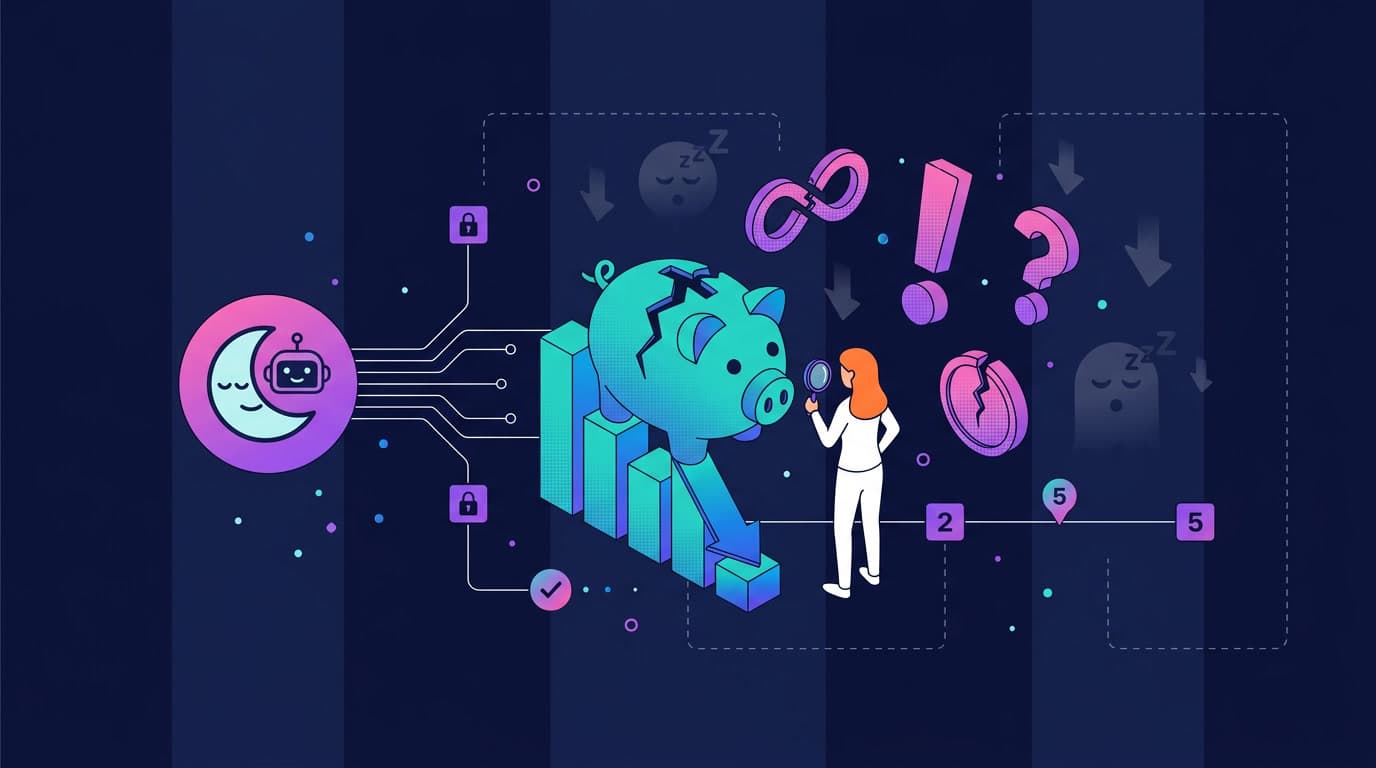
A crypto bot automates execution. It does not create edge. It follows your plan tirelessly, fee for fee. And if that plan loses money, the bot loses it faster and more consistently. Here are five myths that cost beginners real cash.
The one rule that debunks all five crypto trading bot myths: bots automate execution, not edge
A bot is a scheduler and an executor. It's not a profit engine. It cannot forecast a crash. That single distinction is the spine of every myth below. Most crypto trading bot myths collapse the moment you hold onto it.
None of this makes bots a gimmick. Automated trading is common tooling now, and a large and growing share of crypto volume is executed algorithmically. Automation is ordinary, not magic.
A bot doesn't decide whether your trade is smart. It only decides how fast and how faithfully your decision gets executed.
What automation genuinely covers is execution, scheduling, and a toolset around them. One platform's feature list - the Cryptohopper features page - illustrates the scope of typical bot tooling, described as tooling, not a money machine; other platforms offer comparable feature sets. We'll take five myths one at a time. Each gets the same treatment: the myth, why it spreads, and the reality. Plus a scenario you can picture.
Myth 1: 'Bots print money while you sleep'
Why it spreads: influencer "passive income" screenshots and "set it up once" marketing. This framing sells a fantasy: configure the bot, close your laptop, wake up richer. As Coincub notes, "influencers showing off 'passive income' screenshots" contribute to this myth.
The scenario: you leave a grid bot running - a bot that buys dips and sells rips inside a price range - and the market enters a hard downtrend. The bot does exactly what you told it. It keeps buying dips all the way down, bag-holding harder while you sleep.
The reality: automation removes emotion and watches the clock. It does not decide the outcome. The market does. No bot guarantees returns, and anyone promising them is selling a script you don't want to run. As CryptoProfit101 states, bots are "not a magic bullet or a guarantee of success."
Sleeping through the market doesn't stop it from moving against you. It just means you're not awake to see it happen.
Myth 2: 'A bot can fix a bad strategy and turn losses into profits'
Why it spreads: people assume automation adds intelligence. It only adds speed and discipline. Those are not the same thing.
The scenario: you take a strategy with negative expectancy - one that loses a little more often than it wins - and automate it. Now the bot repeats that exact losing setup with perfect discipline. Hundreds of times. Never hesitating, never second-guessing.
The reality: a bot executes a losing plan the same way every time. It doesn't lose magically. It loses consistently, which is arguably worse. Strategies and signals are built or bought, and their quality varies wildly. Browsing any bot marketplace, such as the Cryptohopper marketplace, makes that clear. Selection and judgment stay with you.
A bot is a loyal employee. Give it a bad plan and it executes that plan flawlessly, forever, without complaint.
Myth 3: 'It's set-and-forget - no human needed'
Why it spreads: "automated" gets misread as "autonomous." One word does a lot of damage here.
You tune a mean-reversion bot for a ranging market - it bets that price snaps back to an average. Then conditions flip to a strong trend. The bot keeps fading the move. It sells into strength and buys into weakness, fighting the tape the whole way.
The reality: you still decide whether a setup fits current conditions. Bots need regular review and adjustment by human judgment. Markets shift. Volatility undoes a config that looked bulletproof last week. No automation removes the need for human oversight, which is exactly why understanding managing risk in unstable markets matters more than the automation itself.
Automated is not the same as autonomous. The bot handles the clicking. You still handle the thinking.
Myth 4: 'Bots guarantee returns' - the fee and leverage math nobody shows
Why it spreads: "guaranteed returns" is the single most common scam hook in this space. It works because it skips the arithmetic.
Here's the arithmetic, and you can run it yourself. Every trade carries exchange fees, price spreads, and the occasional failed transaction. Say a strategy nets a 1% edge on a round trip, but you pay a fee on the way in and again on the way out, plus you cross the spread. Halve that edge on costs alone and the margin thins fast; add a few unfilled orders and the strategy tips into the red. A tiny edge does not survive contact with the round-trip.
A 1% edge isn't profit until it survives the round-trip: fees, the spread, and the trades that don't fill can eat the whole thing.
Then there's leverage - borrowing to size up a position. The math is unforgiving: at 10x leverage, ignoring fees and funding, a roughly 5% adverse move against your entry wipes out roughly 50% of your margin - and exchanges typically liquidate you before you hit a 100% loss because of maintenance margin requirements. Even small moves chew through margin fast.
And an honest caveat worth internalizing: plenty of first-time bot builders lose money before they ever make it. The direction of the risk is clear enough. It echoes the same gravity described in the 90% rule in trading - expectations set low tend to age better.
Myth 5: 'Bots are only for whales, experts, and coders'
Why it spreads: early bots genuinely required code and capital. The reputation outlived the reality. As Tradelink.pro notes, "a common myth is that only traders with significant capital can benefit from bots."
The reality: no programming is required for most bots today, and you can start small. Tradelink.pro confirms, "No programming skills are required for most bots today. Platforms are designed with beginners in mind." But accessibility is not the same as guaranteed success. Due diligence on the strategy and the setup still matters. The easy button doesn't do that part for you.
And "one-click" is a marketing word, not a setup guide. Before you connect anything, there's a real security step: locking down your exchange access. Learn how to secure API keys before connecting a bot. Those keys are the door to your funds. If you want a grounded starting point, a rundown of crypto trading tools for beginners is a saner entry than any "get rich" thread.
Low barrier to entry is not low risk of loss. The button is easy to press. The plan behind it is the hard part.
The outside-crypto analogy: cruise control isn't a chauffeur
Fair pushback: if a bot is just execution, why use one at all? Because execution, done with perfect discipline, is worth something real.
Think of cruise control. It holds your speed and takes the fatigue out of a long drive. It will not steer around a curve or read the road ahead. You still drive the car. A bot works the same way. Its narrow, honest benefit is consistency. No revenge trades. No exit you missed because you looked away, no panic sell at 3 a.m.
A bot is cruise control, not a chauffeur. It holds your line without getting tired, but it will not read the road for you.
That's the whole spine again. A bot is worth using for what it does. And it's dangerous the instant you mistake it for what it doesn't.
Red-flags checklist: how to spot a scam bot before it costs you
The scams share a pattern, and once you've seen it you can't unsee it. These are generic warning signs, not accusations against any specific product:
- Guaranteed or fixed returns: the clearest tell there is. Markets don't offer certainty, so neither can a bot. Reputable providers generally avoid hype and do not promise guaranteed returns.
- Black-box strategy: no explanation of how it actually trades. If they can't or won't tell you, assume the worst.
- Unsolicited DM outreach: a stranger pushing you to sign up is a sales funnel, not a favor.
- No docs, no changelog, no visible support: real tools leave a paper trail.
Clear docs, changelogs, and visible support beat a black box with big marketing claims every single time.
The practical takeaway: your decision rule for bots
Use a bot to enforce a plan you can already defend. Not to invent one you don't have. If you can't explain your edge out loud, automating it just makes the losses arrive on schedule.
Budget for fees. Stress-test whether your edge survives the round-trip before you switch anything on. Run the red-flag checklist on every provider. Start small while you learn the setup. And check the publish date on any guide - automation tooling and platform features change quickly, so older reviews may not reflect current capabilities.
Automate a plan you trust and understand. Never outsource the thinking - only the clicking.
FAQ
Can a bot really make money while I sleep?
A bot places and manages trades around the clock without you watching. That's genuinely useful. But whether those trades make money depends on the plan behind them and on the market - not on the automation itself. It executes your decisions while you sleep. It doesn't guarantee they're profitable ones.
Can a bot fix a bad trading strategy or turn losses into profits?
No. A bot executes a losing plan the same way every time. That means it loses consistently rather than fixing anything. Automation adds speed and discipline, not brains. The bot faithfully surfaces a bad plan's losses faster than you would by hand - if the strategy has negative expectancy, running it quicker just brings the pain forward.
What are the red flags of a scam bot?
Watch for guaranteed or fixed returns. Watch for a black-box strategy with no explanation of how it trades. Watch for unsolicited DM outreach pushing you to sign up, and a total absence of documentation, changelogs, or visible support channels. As a general rule, clear docs and open support are a far better sign than heavy marketing claims.
Methodology: this article is an educational explainer, not trading advice. The fee-erosion and 10x-leverage figures are worked arithmetic examples - illustrations of how costs and margin behave, not expected outcomes. No proprietary market data was computed for this piece. Do your own due diligence before acting on any figure here.
This article is for educational purposes only and is not financial or investment advice. Cryptocurrency trading involves substantial risk, including the possible loss of your capital. Do your own research and never trade more than you can afford to lose.

_webp.webp&w=1920&q=75)
_webp.webp&w=1920&q=75)