
Despite the dual shocks of the “Black Saturday” geopolitical escalation in Iran two weeks ago, combined with a disappointing United States Non-Farm Payrolls (NFP) print showing the loss of 92,000 jobs, the $60,000–$64,000 floor for bitcoin has demonstrated unexpected resilience. Oil prices moving nearly 80 percent higher since then will likely play a role in the future Consumer Price Index (CPI) readings, given that energy accounts for approximately 9 percent of the final CPI calculation. Such inflationary pressure implies there will be headwinds for all risk assets.
For bitcoin, however, two forces are currently at play. The first is the tendency for BTC to move further and faster than other risk assets. With its correlation to the higher risk technology sector increasing, while its correlation with safe-haven assets such as gold decreasing, BTC has seen more exaggerated downside moves before other risk assets. However, it also tends to bottom before they do. This dynamic may be in play now, given that BTC has been significantly weaker than the S&P 500 or the NASDAQ for the better part of two quarters.
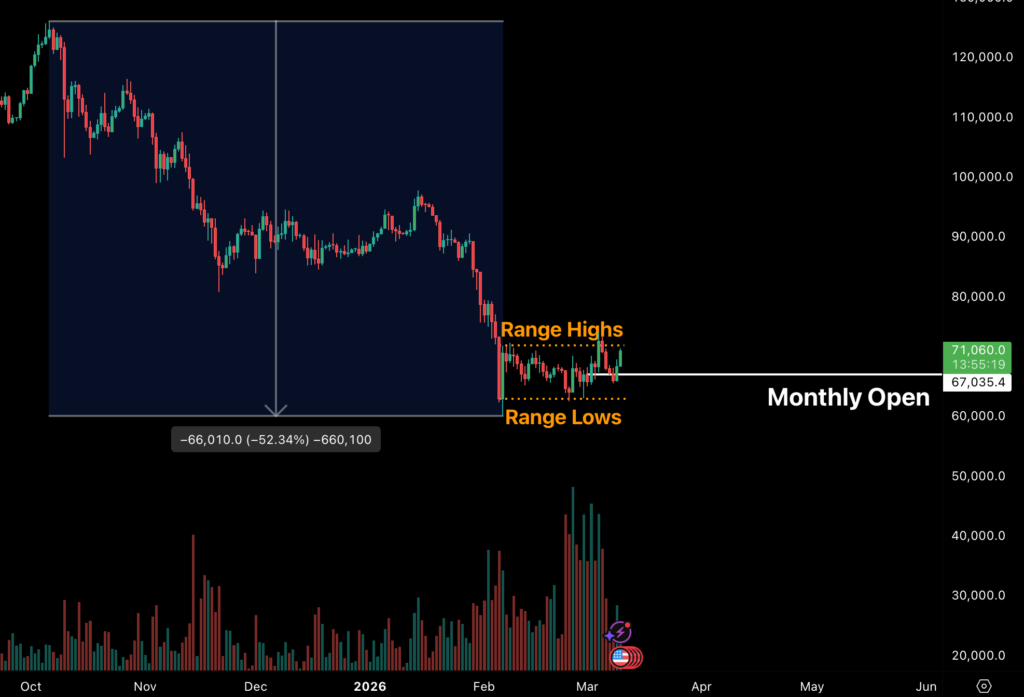
The current regime is best described as the “Great Deleveraging.” Retail sentiment remains highly cautious following a 52 percent peak-to-trough drawdown from October 2025 highs, and consequently the speculative froth that was in the system has now been almost entirely purged. This is evidenced by the Leverage Reset Index (LRI) — the ratio of aggregate open interest (OI) to total exchange spot reserves — which has hit a multi-year low of 0.32.
This indicates that price discovery is now being driven by physical spot demand rather than leveraged derivatives, setting the stage for a high-conviction mean-reversion rally once macro volatility compresses.
1. ETF Flow Regime
The evolution of US spot bitcoin Exchange-Traded Fund (ETF) flows provides the clearest evidence of an institutional regime shift. The market has moved away from the “Carry Trade” era of 2024–2025, when hedge funds used ETFs for basis arbitrage, and into a “Strategic Allocation” phase led by wealth managers and the advisory channel.
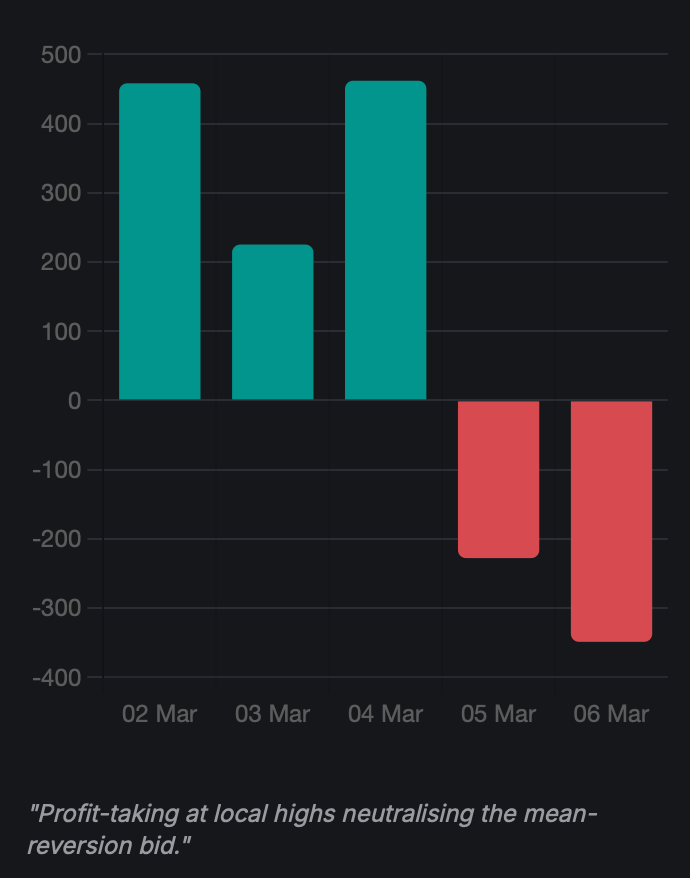
March opened with an aggressive three-day expansion from 2 to 4 March of $1.14 billion in net inflows, only to be met by a $576.8 million distribution wall on 5–6 March as price approached the $72,000 range highs. The session on 9 March confirmed the return of the bid, with a net inflow of $167.1 million, though the figure offers limited encouragement at present.
2. On-Chain Spot Flows: Whale Absorption
On-chain data reveals a significant divergence in holder behaviour. While retail cohorts (wallets holding fewer than 10 BTC) have been net sellers for over 30 days, “whales” (entities holding more than 1,000 BTC) have grown their holdings by 8 percent since the October peak.
3. The Inflationary Bind
An older study by the Federal Reserve indicates that every sustained $10 increase in oil prices can raise US CPI by 20 basis points. This stagflationary threat represents the primary headwind for risk assets. Should oil spike towards $120 and remain there, the Federal Reserve would likely be forced into a hawkish tilt, which would invalidate the recovery thesis. If energy costs stabilise, however, the “digital gold” narrative for bitcoin is likely to strengthen as investors seek sovereign-grade liquidity outside the fiat system.
4. Implied Volatility and Term Structure
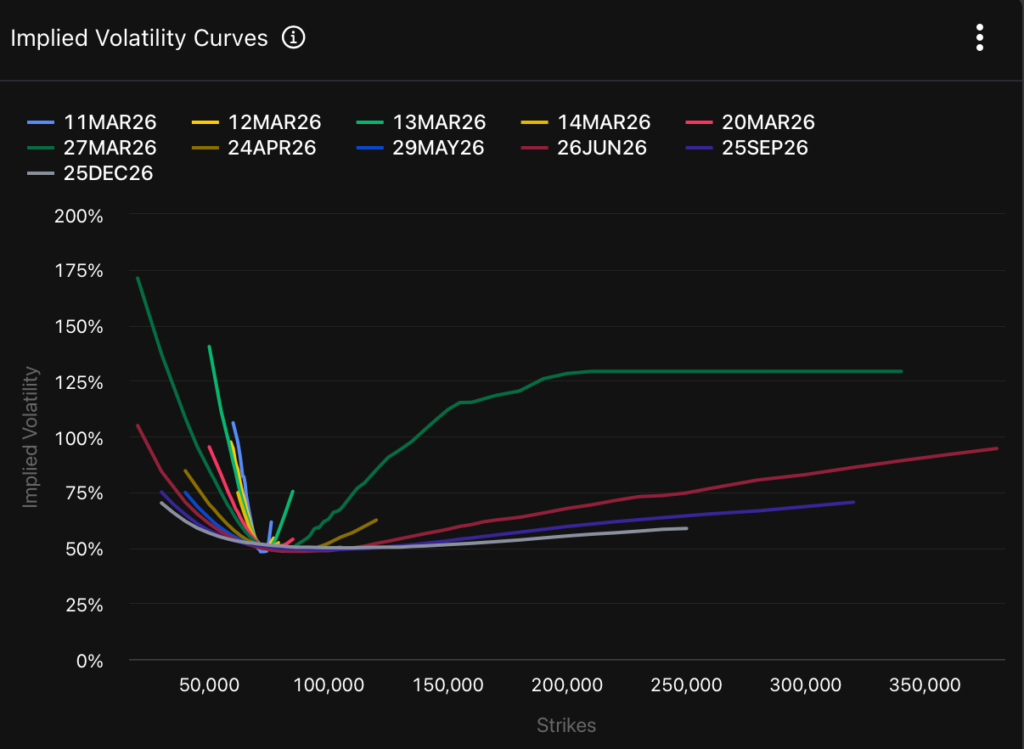
At-the-money (ATM) implied volatility for bitcoin options is currently elevated but not extreme, sitting near 47 percent across most near- to mid-term maturities. This is significantly lower than the 100 percent readings seen during the 2022 bear market, or even the 75–95 percent spikes witnessed in early February.
The volatility term structure remains in mild inversion, with short-dated options carrying a higher premium than longer-dated ones. This is a classic signature of a market pricing in near-term uncertainty — likely tied to the upcoming Federal Open Market Committee (FOMC) meeting and the ongoing Middle East conflict — while maintaining a more constructive long-term outlook.
The post Seller Exhaustion in a ‘Ghost Town’ Derivatives Market appeared first on Bitfinex blog.