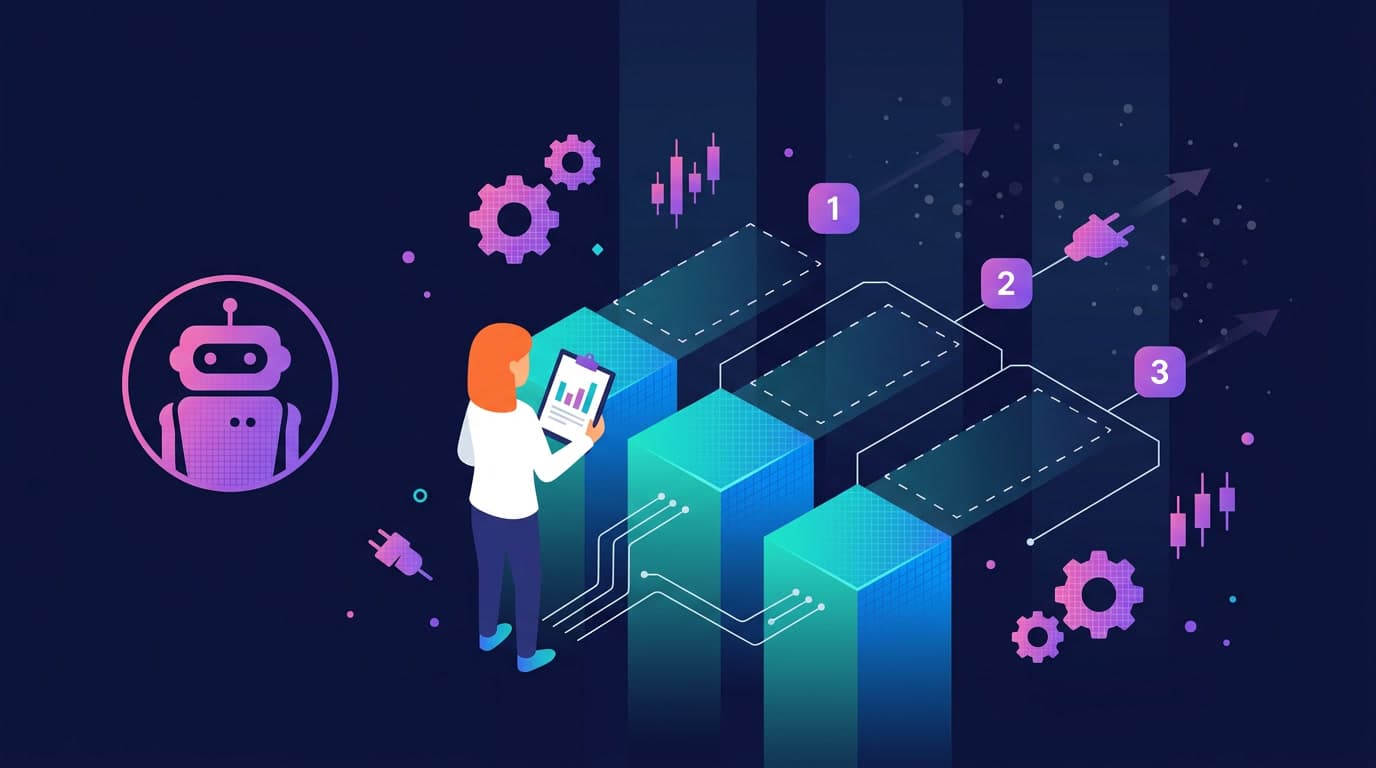
There are three real ways to automate trading - code/API, no-code TradingView routers, and exchange-native bots - and they differ sharply on cost, coding skill, and backtesting. We compared all three, honestly, with sourced numbers and no single-product bias.
The three ways to automate trading (and why the choice matters)
Every ranking page hides behind one product or one vague definition. So let's do the thing none of them do. Name all three approaches and put them side by side.
At its core, automated trading means a system generates orders from predefined rules. It uses technical or statistical inputs instead of your gut. That's the neutral definition, and it's the one Wikipedia's entry on algorithmic trading lands on too. What differs is how you build and run those rules.
Path one: code and API. You write the logic yourself and connect through a broker's API. Alpaca and Interactive Brokers are two commonly cited examples in communities like r/algotrading, among several brokers offering API access. Full control, full responsibility, real programming required.
Path two: no-code TradingView routers. Tools like TradersPost and PickMyTrade take an alert from your TradingView strategy and fire it - via webhook, a small automated message one app sends another - to a connected broker. You bring the strategy. They handle the plumbing.
Path three: exchange-native crypto bots. Platforms like Cryptohopper run DCA (dollar-cost-averaging), grid, or signal bots that execute a predefined strategy without you touching code - this describes functionality, not expected returns. The automation lives where your crypto already trades.
There is no single best way to automate trading. There are three distinct paths, and the right one depends on whether you can code, what you trade, and how much you want to monitor.
So frame your decision around yourself. Your coding ability. Your asset class. Your time budget. Not some listicle's "#1 pick."
How common is automated trading, really?
Automation isn't a fringe experiment run by a few basement quants. It dominates the markets you're trading in.
By one single-source, unverified estimate (papertradingjournal.com), roughly 70% of U.S. equity trades are executed by automated systems - treat this as a claim from one low-authority source, not verified regulatory data such as SEC or FINRA market-structure reports. The same source separately estimates that 60-75% of global equity trading volume is algorithmic.
By these estimates, most global equity volume is already algorithmic. But that dominance is a fact about institutions, not a promise about your results.
Forex is where the sources fight. One estimate (quantifiedstrategies.com) puts automated forex volume near 92%; another (papertradingjournal.com) puts it closer to 58%. These are anecdotal industry estimates from low-authority blogs, so we present them as a range, not a headline number. Suspicious? You should be, if someone quotes a single confident forex figure.
Futures? More than half of futures transactions reportedly run through automated systems, per papertradingjournal.com. The pattern holds across asset classes. Machines move most of the volume.
Here's the part the sales pages skip. Prevalence at the top says nothing about retail profitability. Institutions dominate because they can - not because automation prints money for whoever switches it on.
The head-to-head comparison
This is the objective, product-neutral scorecard the ranking pages refuse to build. Six dimensions, three paths, no favoritism.
Code / API - Alpaca, Interactive Brokers
- Cost: Platform/API access is often low or free; the real cost is your time and skill.
- Coding requirement: High - you write and maintain the logic.
- Supported assets: Broadest reach - equities, options, futures, crypto depending on broker.
- Backtesting: Strong, but you build or wire up the framework yourself.
- Ease of use: Low for non-programmers; steep learning curve.
- Best for: Developers who want full control and will maintain infrastructure.
No-code TradingView routers - TradersPost, PickMyTrade
- Cost: Subscription, usually on top of a TradingView plan.
- Coding requirement: None - but you configure webhooks and build the TradingView strategy.
- Supported assets: Stocks, futures, options, crypto via connected brokers.
- Backtesting: Done inside TradingView before you route alerts live.
- Ease of use: Moderate - easier than code, not effortless.
- Best for: Existing TradingView users with strategies and alerts already firing.
Exchange-native crypto bots - Cryptohopper
- Cost: Tiered subscription - check the current Cryptohopper pricing yourself before committing.
- Coding requirement: None to run DCA, grid, or signal bots.
- Supported assets: Crypto-focused, across connected exchanges.
- Backtesting: Built-in backtesting and paper trading, plus a strategy Marketplace - see the full feature set.
- Ease of use: High for a hands-off setup.
- Best for: Hands-off crypto users who want ready-made, testable strategies.
"No-code" does not mean "no work." Every path still requires you to define a strategy, connect a broker or exchange, and test before going live.
Notice what didn't happen. We didn't crown a winner. The right row is the one that matches you.
Three myths that cost retail traders money
Product pages sell these myths on purpose. We'll take each one apart.
Myth 1: "set and forget." Automation needs monitoring. Connections drop. APIs fail. Markets regime-shift overnight, and a strategy tuned for a calm range gets shredded in a trend. Walking away is how a small problem becomes a large one.
Myth 2: "bots always beat humans." A bot executes a flawed strategy exactly as faithfully as a good one. OANDA markets automation as delivering disciplined, consistent execution - a marketed benefit, not a verified guarantee. And discipline cuts both ways.
Automation doesn't remove risk. It removes your emotions, which means a losing strategy gets executed with perfect, tireless discipline all the way down.
Myth 3: "automation removes risk." It removes emotional interference. Not market risk, not glitch risk, not the risk of a bad strategy. Those are all still yours.
What about profitability? One low-authority source, tv-hub.org, claims roughly 60% of retail algo traders show positive annual returns versus 5-10% of manual day traders. We flag that hard: single source, unverified, and not representative of typical outcomes - aggregate results do not predict your individual outcome. Read it as an unverified claim someone made, not a promise.
And keep the big institutional numbers in their own box. One low-authority source (tv-hub.org) reports institutional quant-fund inflows of $543B in 2025 - unconfirmed against a primary source, and reflecting dedicated risk desks and teams retail traders cannot access. This is not a benchmark individual traders can expect to approach.
The honest trade-offs and failure modes
Sales pages omit these entirely. That's exactly why they matter. The failure modes below are widely cited across industry commentary but are not verified against a primary regulatory source; treat them as commonly noted risk factors.
Technical glitches are a frequently cited landmine. A dropped connection or a failed API call at the wrong moment turns a managed position into an unmanaged loss. Institutions are widely reported to use kill-switches for this reason.
Then there's over-optimization - curve fitting. You tune a strategy until the backtest looks flawless. And flawless is the warning sign. A model bent perfectly around past data usually bends the wrong way live.
The most dangerous number in automated trading is a beautiful backtest. Curve-fitting produces perfect historical results and disappointing live ones.
Latency and slippage close the gap between fantasy and fills. The price your backtest assumed and the price you actually get diverge, especially in thin or fast markets. Slippage - the difference between expected and executed price - quietly eats returns that looked clean on paper. It happens fast.
Finally, scam bots. Any pitch promising "guaranteed returns" or get-rich-quick automation is waving a red flag at you. Real platforms describe what a tool does. They don't promise what you'll earn. One common risk-mitigation practice cited by experienced traders is paper trading and backtesting before committing real funds - not a guarantee against loss.
An analogy: cruise control isn't self-driving
A trading bot is cruise control. Not a self-driving car. The distinction is the whole game.
Cruise control holds your set speed brilliantly. And it drives you straight into a traffic jam if you never touch the brake. It does exactly what it was told, including into a wall. That's your automated strategy - perfect execution of your instructions, and only your instructions.
A trading bot is cruise control, not a self-driving car: it holds your strategy's speed perfectly, but it will not brake for a hazard it was never told to watch for.
"But institutions run fully automated with nobody watching," someone always says. They don't. They are widely reported to run risk desks, kill-switches, and monitoring teams around the clock - infrastructure retail traders typically skip. The human stays responsible for the road ahead. Always.
Who each approach is actually for
Match the tool to yourself, not the hype. Here's the honest mapping.
The coder gets the most from the code/API path. Comfortable writing logic and maintaining infrastructure? Then code/API platforms such as Alpaca or Interactive Brokers give you flexibility that no-code tools typically don't offer. Cryptohopper users going this route can build custom tools on the Cryptohopper API.
The TradingView user fits the no-code router or webhook approach. You already have strategies and alerts. You just need something to execute them. For a concrete non-broker example, see this walkthrough of no-code automation with n8n, Zapier, and Make.
The hands-off crypto beginner is the natural fit for exchange-native bots. They come with built-in paper trading and ready-made strategies from the strategy and signal Marketplace. Marketplace strategies are provided by third parties, and their past performance, if shown, does not guarantee future results. Still assembling your kit? Start with these crypto trading tools for beginners.
Everyone, regardless of path: start with paper trading and small size. No exemptions.
Your practical next step
Pick the row from the comparison that matches your coding ability and asset class. Coder, TradingView user, or hands-off crypto beginner. That's the honest filter, not "which tool is best."
Then backtest. Then paper trade the exact setup you'd run with real money, and watch how it behaves. Okay, that's slightly oversimplified. What actually happens is you'll tweak, retest, and tweak again before anything feels ready - set a monitoring routine and a loss limit before going live. And verify current pricing and features on any platform's own page before you subscribe.
The winning move on day one isn't going live. It's paper trading the exact setup you'd run with real money, then watching how it behaves before a single dollar is at stake.
FAQ
Do I need to know how to code, or are there real no-code solutions?
Real no-code solutions exist. Exchange-native crypto bots let you run DCA, grid, or signal strategies without writing a line. And TradingView routers execute alerts through webhooks you configure rather than program. But "no-code" still means defining a strategy, connecting an exchange or broker, and testing it. The code path - Alpaca, Interactive Brokers - is only necessary if you want full custom control.
Can I automate my TradingView alerts so they execute real trades?
Yes. That's precisely what no-code routers like TradersPost and PickMyTrade do. They receive a TradingView strategy alert via webhook and route it to a connected broker or exchange to place the order. You build and backtest the strategy in TradingView first, then wire the webhook. It's approachable, but it isn't automatic magic. You still configure and monitor it.
Is automated trading really "set and forget," or does it need monitoring?
It needs monitoring. Connections drop, APIs fail, and market conditions shift in ways a fixed strategy wasn't built for. Even institutions running fully automated systems are widely reported to keep risk desks and kill-switches watching. Treat automation as cruise control - it holds your strategy's speed but won't brake for a hazard it was never told about. Set a routine and a loss limit.
This article is educational information about automation tools and methods, not financial or investment advice; consult a licensed professional before making trading decisions.
Methodology: This article contains no proprietary or original statistics. All quantitative claims are externally sourced and attributed to the cited third parties, several of which are single-source, low-authority estimates flagged as unverified and lacking regulatory backing. Market-share and profitability figures reflect those sources, not Cryptohopper measurements, and do not predict individual results. Verify all platform pricing and features on each provider's own page before subscribing.
This article is for educational purposes only and is not financial or investment advice. Cryptocurrency trading involves substantial risk, including the possible loss of your capital. Do your own research and never trade more than you can afford to lose.

_webp.webp&w=1920&q=75)
_webp.webp&w=1920&q=75)