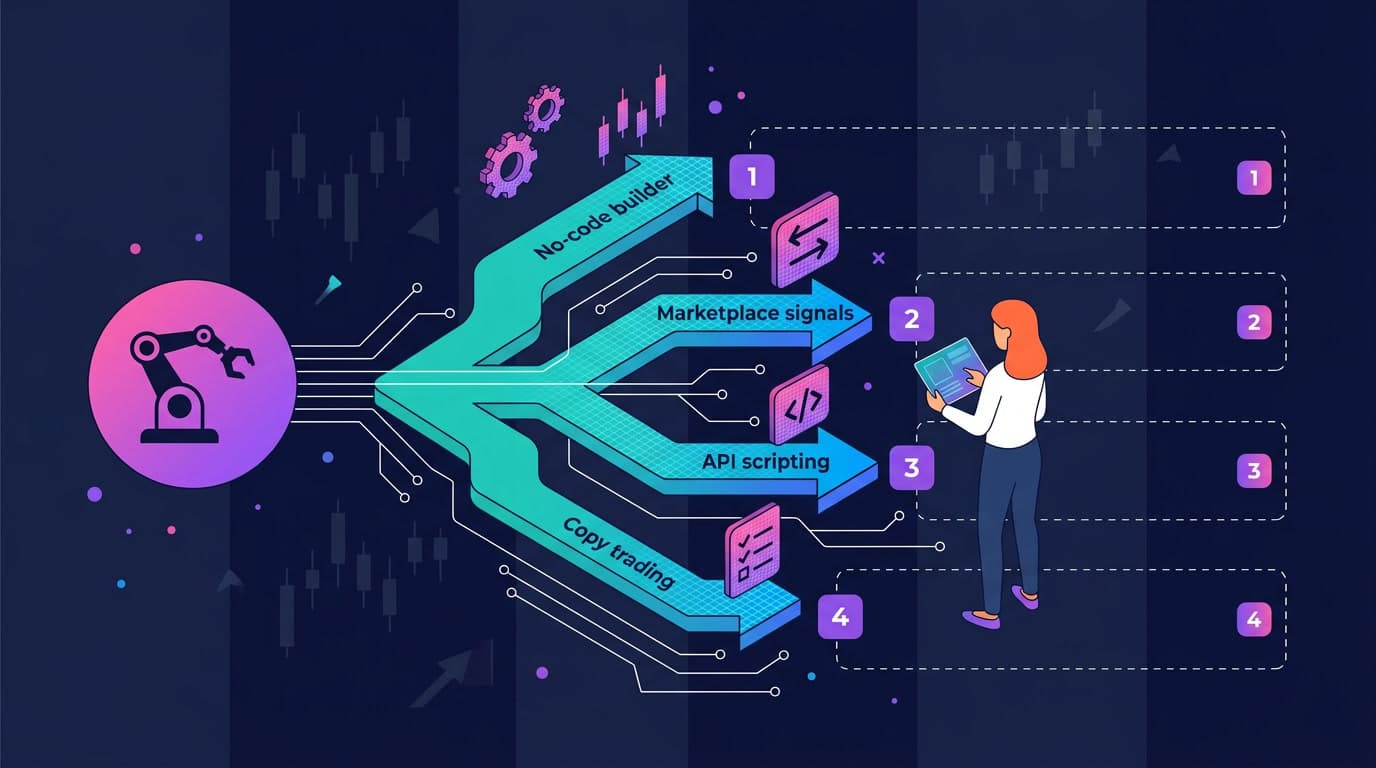
There are four realistic ways to automate crypto trading: no-code bot platforms, TradingView-webhook bridges, self-coded API bots, and copy-trading or signals. The right one depends on your budget, your coding ability, and how much control you want. This comparison is educational and describes general product categories; it is not a personalized recommendation for your situation. A note on sourcing before we start: this piece is published by Cryptohopper, which offers one of the no-code platforms and a marketplace discussed below, so weigh the comparison accordingly.
The four automation paths at a glance
Every vendor page tells you its path is the best path. We won't. Below is each of the four ways to automate, scored on the four things that actually decide the fit: monthly cost, learning curve, control, and the crypto-retail user it suits.
Read the numbers as ranges, not promises. A "low" cost path can cost you dearly in hours. A "high control" path hands you enough rope to hang your account. The honest version lays it all out side by side.
- No-code bot platforms: Subscription tiers, typically low-to-mid - Low - Moderate - None - Beginner-to-intermediate traders who want tooling without a dev background
- TradingView-webhook bridges: Cheap-to-mid (TradingView plan + bridge fee) - Moderate - High on signal, bridge-dependent on execution - None-to-low - Discretionary traders already living inside TradingView
- Self-coded API bots: Near-zero software, high in time - Steep - Total - Yes, real coding - Developers who want to own every line
- Copy-trading and signals: Low; often a per-strategy subscription - Low - Low - None - Hands-off traders who accept less control for less work
No-code bot platforms
You build strategies in a visual editor, backtest them, paper trade, then go live. No code. Cryptohopper is one example of this path.
- Monthly cost: subscription tiers, typically low-to-mid; see the pricing tiers for the current bands.
- Learning curve: low. You learn an interface, not a language.
- Control: moderate. You get built-in backtesting, paper trading and live execution, but you work inside the platform's feature set.
- Coding required: none.
- Best-fit user: beginner-to-intermediate crypto traders who want tooling without a dev background.
The limit of this path is its own ceiling. Want behavior the platform doesn't support? You can't just write it yourself. We'll say that plainly. It's the trade-off you accept for skipping the code. For a sense of how two no-code platforms actually differ, see our honest Cryptohopper vs 3Commas comparison.
TradingView-webhook bridges
You write alerts in TradingView. A bridge service forwards them as orders to your exchange or broker API. The signal logic lives in TradingView; the bridge just executes.
- Monthly cost: cheap-to-mid - a TradingView plan plus a bridge fee.
- Learning curve: moderate. Pine Script helps but is not strictly required for simple alerts.
- Control: high on the signal side, but execution depends on the bridge and your connectivity.
- Coding required: none-to-low.
- Best-fit user: discretionary traders already living inside TradingView charts.
The weak point is the handoff. Your signal can be perfect and still miss a fill if the webhook drops or the bridge lags.
Self-coded API bots
You connect directly to an exchange API and write the whole system yourself in Python or similar. Total control, total responsibility.
- Monthly cost: near-zero in software, high in time - the cost is your hours.
- Learning curve: steep. You need markets, programming, and risk management together.
- Control: total. Nothing is off-limits.
- Coding required: yes, real coding.
- Best-fit user: developers who want to own every line.
Strategy development here "requires deep understanding of markets, programming and risk management," as Wikipedia's automated trading entry puts it bluntly. The "free" path is the most expensive in effort.
Copy-trading and signals
You follow someone else's strategy through a marketplace. The Cryptohopper Marketplace is one example. Low effort, low control. The outcome rides on the strategy you chose to follow.
- Monthly cost: low; often a subscription to the signal or strategy.
- Learning curve: low.
- Control: low. You do not set the rules; you rent them.
- Coding required: none.
- Best-fit user: hands-off traders who accept less control for less work.
No single automation path wins on everything. You trade cost for control and convenience for customization, and the right path is the one whose trade-offs you can live with.
How common is automation - and does it make money?
Automation is not a fringe tactic. It is how a large share of the market already trades. Widely cited industry estimates put the machine-executed share of U.S. and global equity volume in the 60-75% range, with forex and futures also heavily automated. Treat every number in this section as a directional estimate: the specific figures that circulate in retail write-ups - including a secondary report pegging U.S. equities near 70%, forex near 58%, and futures above 50% - trace back to secondary sources rather than primary regulator or exchange data.
Profitability is a different question, and a shakier one. One single-source write-up claimed a majority of retail algo traders showed positive annual returns versus a much smaller slice of manual day traders - but it disclosed no methodology, and it sits right next to the dispersion data below, where the same kinds of tools produced a large top-decile gain and a comparable bottom-decile loss. Interrogate any "automation wins more" figure; don't bank on it predicting your own results.
On the crypto side, a marketing blog cited a CoinGecko dataset for median annual returns and win rates across a sample of automated signal traders. The primary report isn't publicly locatable, so it stays a secondhand citation - anecdotal, not audited.
Prevalence is a fact about the market; profitability is a distribution.
Automation is how much of the market already trades, but prevalence is not profitability, and no statistic here predicts what any individual trader will earn.
The 'set it and forget it' myth
The Reddit belief that automation equals passive, guaranteed profit dies on contact with the dispersion data. That same secondhand CoinGecko citation reportedly showed a wide gap between the best and worst deciles of signal traders - a large gain at the top and a comparable loss at the bottom, on the same tools. Even as an anecdote, the direction of that spread is the point: same tools, opposite outcomes.
That spread is the whole story.
The edge didn't live in the automation. It lived in the strategy and the hands running it.
The same automation toolkit produces a gain for the disciplined and a loss for the careless. The edge lives in the strategy, not the automation.
Automation does not delete the work. It relocates it. Instead of staring at charts, you spend your time on strategy design, backtesting, and monitoring. It trims the emotional, gut-call decisions, but strategy quality still governs the outcome, and even a running bot needs eyes on it. As ATAS notes, automated systems still require ongoing monitoring to confirm they function and to adapt as conditions change.
The full lifecycle: strategy, backtest, paper trade, live, monitor
Broker explainers wave you toward a "get started" button. The honest lifecycle has five stages.
First, write the strategy - the rules that fire orders. Second, backtest it against historical data; run it across a window long enough to include at least one full trending phase and one choppy, sideways phase, not just the last good month. Third, paper trade it: run it on live prices with fake money. Fourth, go live small - size each position so a single bad trade is an annoyance, not a wound. Fifth, monitor and adapt.
The paper-trade stage is the bridge most people burn. We built a four-week paper-trading protocol precisely because a clean backtest tells you almost nothing about live behavior. Overfitting hides in a backtest. That's a strategy tuned so tightly to past data that it looks flawless, then breaks the moment new data arrives.
On a no-code platform, the backtest-to-paper-to-live progression is a workflow you click through, not a codebase you maintain. That's the convenience you're paying the subscription for.
Skip the paper-trading stage and you are not automating a tested strategy - you are automating a hypothesis with real money behind it.
Disadvantages and failure modes nobody mentions
Marketing pages leave these off the price tag. We'll put them back on.
Overfitting is the first. A strategy sculpted to past data breaks on new data, and the backtest never warns you. The second is technical: API outages, missed fills, connectivity drops. Your logic can be right while the pipe is down.
Third are black-swan gaps. Automation executes into an illiquid or gapping market, filling you at prices no human would accept. Fourth is the quiet one: monitoring burden and over-optimization creep. You keep tweaking until you've fitted the bot to noise.
These apply to every path. No-code platforms included. A visual editor doesn't immunize you against a market that gaps through your stop. It happens fast.
Every failure mode of automated trading - overfitting, outages, black-swan gaps - is a cost that marketing pages leave off the price tag.
Cruise control, not a self-driving car
Here's the mental model that keeps you honest. Automated trading is cruise control. It holds the speed you set. It doesn't watch the road for you.
"But institutional quant funds prove automation prints money," someone always says. Set aside whether that premise is even true - no verified figures on institutional automated-trading profits are cited here, and even if they existed, they would not predict retail results. Institutional desks run infrastructure, data, and risk teams that no retail trader has. That edge doesn't transfer. The retail dispersion data - the wide gap between the best and worst deciles described above - is the counterargument. It's made of real traders using the same kinds of tools you would.
The self-driving-car fantasy causes the worst retail losses. It tells you to stop watching. You can automate the driving. You can't outsource the responsibility.
Automated trading is cruise control, not a self-driving car: it holds the strategy you set, but you are still responsible for watching the road.
Who each path is for
Match the path to yourself, not to a vendor's pitch.
Beginner with no coding? The no-code bot platform has the lowest barrier and ships backtest and paper tools in the box. If you're a discretionary trader already glued to TradingView, a webhook bridge carries your existing alerts into execution without rebuilding anything. If you're a coder who wants to own every decision, the self-coded API bot is yours. And if you want hands-off, copy-trading or signals through a marketplace trades control for effort. You accept you're following, not building.
Okay, that's slightly oversimplified. What actually happens is most traders drift between these over time - a copy-trader starts tweaking, a no-code user starts eyeing the API. The real fork is builder versus follower. We dug into that decision in copy-trading vs bot-building, and the broader path comparison lives in how to automate trading: the three real paths compared.
There is no best automation path - only the path that matches your time, budget, and appetite for building versus following.
FAQ
These answers describe general categories and are not personalized recommendations.
What's the difference between no-code bot platforms, webhook bridges, and coding my own bot?
A no-code platform lets you build, test and run strategies in a visual interface with no programming. A webhook bridge takes signals you write in a tool like TradingView and forwards them to an exchange API for execution. A self-coded API bot is a program you write and host yourself - maximum control, maximum effort.
Do I need to know how to code to automate crypto trading?
No. No-code bot platforms and copy-trading or signal marketplaces require no programming. Webhook bridges sit in the middle - basic alerts need little or no code. Only the self-coded API path requires real coding.
How much does automated trading cost to run each month?
It ranges from near-zero software cost for a self-coded bot (paid instead in your time) to subscription tiers for no-code platforms and signal services. Webhook setups typically stack a charting plan on top of a bridge fee. Check current bands on the relevant pricing pages before you commit.
Is it 'set it and forget it' or do I still have to monitor the bot?
You still monitor it. Even fully automated systems need oversight to confirm they are running and to adapt to changing conditions, and the wide performance dispersion between traders shows strategy quality and attention still drive results. Automation reduces discretionary decisions; it does not remove responsibility.
Methodology: the prevalence and performance figures referenced here come from secondary sources that have not been independently verified against primary data - exchange or regulator reports for equity/forex/futures algo share, and the original CoinGecko study for crypto signal-trader performance, whose primary report isn't publicly locatable. Treat all figures in this article as unconfirmed estimates and historical in nature; past returns are not indicative of future results. The comparison scoring reflects general characteristics of each automation path, not a ranking of specific products.
This article is for educational purposes only and is not financial or investment advice. Cryptocurrency trading involves substantial risk, including the possible loss of your capital. Do your own research and never trade more than you can afford to lose.

_webp.webp&w=1920&q=75)
_webp.webp&w=1920&q=75)