Margin trading isn’t new. Long before crypto existed, traders were borrowing capital to take larger positions in stocks, commodities and fiat currencies. Cryptocurrency simply took the same idea and made it available 24/7 to anyone with an internet connection.
The premise is simple: borrow capital to control a larger position than your own funds would allow. Done well, leverage can amplify returns. Done poorly, it amplifies losses just as quickly.
That’s why understanding margin matters before placing your first trade.
Launched in 2012 as a peer-to-peer Bitcoin exchange with margin lending at its core, Bitfinex pioneered leveraged crypto trading long before it became an industry standard. More than thirteen years later, it remains one of the industry’s deepest and most battle-tested trading venues, trusted by professional traders, institutions and some of the market’s largest market participants.
In this guide, we’ll explain what margin trading is, why traders use it, what makes traders choose to do margin trades on Bitfinex, and how to place your first margin trade.
What Is Margin Trading?
Margin trading lets you borrow money to open a position bigger than the capital you actually have.
Say you’ve got $1,000 and you think Bitcoin’s about to go up.
With regular spot trading, $1,000 buys you $1,000 of BTC. If it rises 10%, you’re up $100.
With margin, you can borrow more and trade bigger. At 3x leverage, that $1,000 controls a $3,000 position.
If Bitcoin rises 10%:*
Spot Trading
Margin Trading (3x)
Initial capital
$1,000
$1,000
Position size
$1,000
$3,000
BTC price change
+10%
+10%
Profit
$100
$300
Return on capital
+10%
+30%
Bigger exposure, bigger profit. But it works the other way too.
If Bitcoin falls 10%:*
Spot Trading
Margin Trading (3x)
Initial capital
$1,000
$1,000
Position size
$1,000
$3,000
BTC price change
-10%
-10%
Loss
-$100
-$300
Return on capital
-10%
-30%
* The figures, rates, leverage and returns in this example are hypothetical and provided for illustrative purposes only. Actual results may differ and will be impacted by interest charges. Bitfinex makes no guarantees regarding any outcome. Margin trading involves a high degree of risk, including the risk of losing more than your initial collateral, and may not be suitable for everyone. Leverage can work against you as well as for you. The peer to peer funding market on the Site is available only pursuant to the Terms of Service.
On Bitfinex you can go up to 10x on margin. More leverage means bigger gains, but bigger losses too. Push it too far and even a small move against you can trigger a liquidation, where your position gets closed automatically because your collateral can’t cover it anymore.
Why Do Traders Use Margin?
Margin isn’t just about betting bigger. Traders use it for a few different reasons.
Get more exposure
Leverage lets traders control a larger position without putting up the full amount upfront. That means more buying power, while keeping some capital free for other trades or opportunities.
Short the market
Markets don’t only go up. Margin trading lets traders profit from falling prices by opening short positions. For many traders, the ability to trade both directions is just as valuable as leverage itself.
Hedge Existing Positions
Margin isn’t only about taking risk. It can also help manage it.
For example, a long-term Bitcoin holder expecting short-term weakness might open a short position to offset potential losses, without having to sell their BTC holdings.
Run more advanced setups
Bitfinex supports advanced order types including Market, Limit, Stop, Trailing Stop, OCO and Scaled orders, giving traders more control over how they enter and exit positions.
It also supports a broad range of collateral assets, from stablecoins and cryptocurrencies to tokenised gold, allowing traders to structure risk and manage capital in ways that go beyond a standard spot exchange.
Why traders trade margin on Bitfinex
For more than thirteen years, Bitfinex has been one of crypto’s leading venues for leveraged trading, trusted by professional traders, institutions and some of the market’s largest participants.
Here’s what sets it apart.
Most Exchanges Lend You Their Money. Bitfinex Doesn’t.
This is one of the biggest differences between Bitfinex and most other exchanges. On many platforms, margin funding comes directly from the exchange itself, which also sets the borrowing rates.
Bitfinex works differently.
Every margin position on Bitfinex is funded through a live peer-to-peer marketplace where traders borrow directly from other users. Bitfinex provides the infrastructure, matching engine and liquidation system, but the funding itself comes from the market.
That means interest rates are determined by real supply and demand rather than by an internal lending desk. The result is a marketplace that works for both sides: borrowers gain access to flexible funding at market-driven rates, while lenders earn interest by providing liquidity. Because the ecosystem is powered by users, rates adjust naturally as market conditions change.
This model has been running for more than thirteen years, making Bitfinex one of the oldest and most established peer-to-peer funding markets in crypto.
Zero trading fees
Trading costs matter. Since December 2025, Bitfinex charges zero maker and taker fees on spot, margin and derivatives. The only cost of holding a margin position is the funding interest you pay lenders, not trading fees to the exchange.
The home of the whales
Liquidity attracts liquidity. For more than a decade, Bitfinex has been the trading venue of choice for many of crypto’s largest market participants, creating a quiet but powerful advantage:
- One of the deepest funding books in the industry.
- Competitive funding rates.
- And the ability to execute at size, whether markets are calm or highly volatile.
It’s also why Bitfinex’s BTC margin long and short data remains one of the most closely watched sentiment indicators in crypto.
The deeper the liquidity, the bigger the players it attracts. It’s a thirteen-year flywheel that new platforms can not replicate overnight.
A Wider Range of Collateral
Your collateral doesn’t have to be pure crypto. On Bitfinex you can pledge over 30 different assets against your margin positions. That spans cryptocurrencies like BTC and ETH, stablecoins like USDt, fiat currencies like USD, tokenised gold (XAUt), and a wide range of other digital assets.
The result is more flexibility in your portfolio management strategy and what backs your trades.
Professional Tools, Not a Beginner Kit
Professional traders need more than a Buy button.
Bitfinex offers a full suite of trading tools designed to help traders build, automate and protect their positions.
- Market and Limit orders for instant or price-specific entries.
- Stop and Trailing Stop orders to manage downside risk and protect gains.
- OCO orders to place a profit target and stop loss simultaneously.
- Scaled orders to automatically ladder into or out of a position across a price range.
- And subaccounts to separate funds, strategies and risk.
While many exchanges offer a simplified experience designed for beginners, Bitfinex gives traders the tools they need as their strategies become more sophisticated.
Because serious trading deserves serious infrastructure.
How Margin Works on Bitfinex
When you trade on margin on Bitfinex, the assets in your Margin Wallet act as collateral. In simple terms, they are assets you already own that let you borrow additional funds to trade.
Bitfinex accepts a broad range of collateral, from major cryptocurrencies like BTC and ETH, to stablecoins like USDt, fiat such as USD, and tokenised gold (XAUt). Most exchanges only accept crypto and stablecoins, so accepting fiat and tokenised gold as collateral is relatively uncommon.
On Bitfinex, everything in your Margin Wallet works together to back your open positions. That’s called cross-collateral.
Instead of locking specific collateral to each trade, Bitfinex looks at your whole Margin Wallet and all your positions together. That gives you more room to move, since a winning position or spare collateral can prop up one that’s temporarily down. The flip side is that risk is shared across your whole Margin Wallet.
That’s why good traders watch more than just price. They keep an eye on how much leverage they’re using, what their collateral’s worth, how big their positions are, and how much they’re willing to lose.
Margin trading isn’t about borrowing as much as you can. It’s about managing risk and staying in the game long enough for the good setups to show up.
How to Start Trading Margin
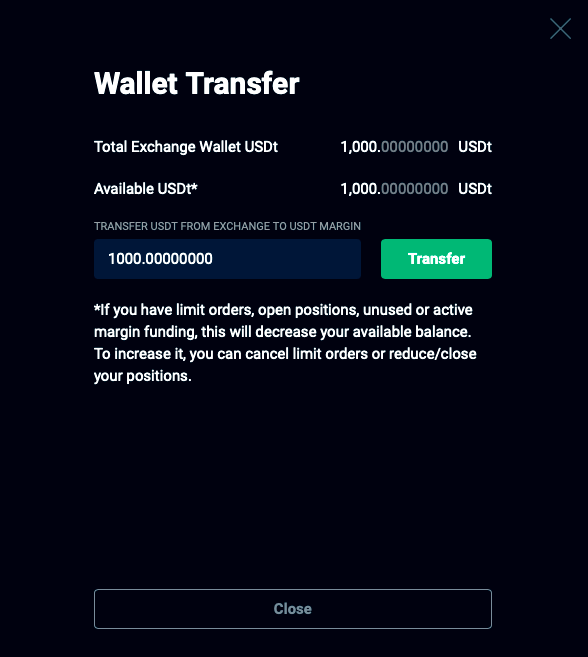
Step 1: Fund your Margin Wallet
First, transfer assets into your Margin Wallet. These assets become your collateral, meaning the funds Bitfinex uses to determine how much you can borrow.
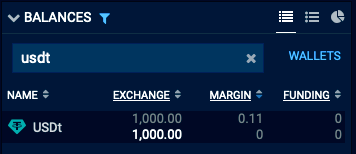
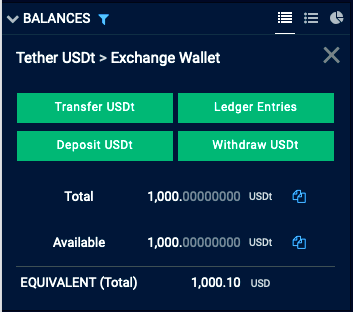
Click on balance and “Transfer USDT”
Bitfinex supports a broad range of collateral assets, including:
- BTC
- ETH
- USDt
- USD
- XAUt (tokenised gold)
- Other supported digital assets
The value of your collateral, after any applicable haircuts, determines your borrowing power.
Step 2: Choose your collateral
Different assets come with different characteristics, and the right choice depends on your goals and risk tolerance.
BTC and ETH provide exposure to crypto markets, which can be useful if you want your collateral to potentially appreciate in value. However, their prices can be volatile, which may increase liquidation risk.
Stablecoins such as USDt are designed to maintain a stable value, which can make them more predictable as collateral, but they do not offer price upside.
What’s a haircut?
A haircut is the percentage reduction Bitfinex applies to an asset’s market value when calculating how much collateral it contributes.
More volatile assets generally receive larger haircuts, while more stable assets receive smaller ones.
Asset
Market value
Example haircut
Counts as
USDt, BTC, ETH
$10,000
0%
$10,000
SOL
$10,000
Around 30%
About $7,000
XRP
$10,000
Around 50%
About $5,000
ADA
$10,000
Around 70%
About $3,000
The real numbers are live on in the platform and shift with market conditions, so treat the figures above as ballpark.
The real numbers can be checked directly on the Trading Page UI under “Collateral Info” or API EP https://api-pub.bitfinex.com/v2/conf/pub:spec:margin.
Step 3: Pick a pair
Once your Margin Wallet is funded, choose the market you want to trade.
If you think the price will rise, you can open a long position/ margin buy.
If you think the price will fall, you can open a short position/ margin sell.
Bitfinex offers margin trading across a wide range of cryptocurrency pairs, with leverage and margin requirements varying by market.
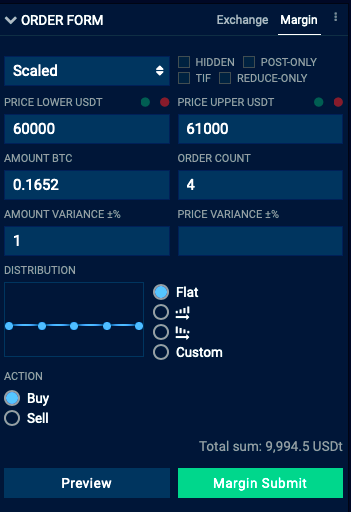
Step 4: Set your order
Choose the order type that matches your strategy.
Bitfinex supports:
- Market Orders
- Limit Orders
- Stop Orders
- Trailing Stops
- OCO (One Cancels Other) Orders
- Scaled Orders
More advanced order types give traders additional control over entries, exits and risk management.
You can also use subaccounts to separate strategies and manage risk independently.
Step 5: Keep an eye on your position
Once your trade is open, watch these three things closely.
Margin Ratio
This measures the health of your position. If it falls too low, your position may be liquidated.
Funding Costs
Borrowed funds accrue interest. On Bitfinex, funding rates are determined by supply and demand in the peer-to-peer funding market, so costs can vary over time.
Volatility
Crypto markets can move quickly. Many traders use stop-losses and predefined risk limits to help manage downside risk.
Liquidation, and How to Avoid It
Every margin trader should understand liquidation. It happens when your net equity falls below the minimum required to support your open positions. At that point, positions may be closed automatically to limit further losses.
Here are the key terms to know:
Term
What it means
Initial Margin
Your own funds you must put up to open a position. Think of it as your down payment. The rest is borrowed.
Varies by pair, for example BTC/USD 10% (up to 10x) and ETH/USD 20% (up to 5x).
Collateral
Assets in your Margin Wallet that secure the borrowed funds. This is what Bitfinex can use to cover losses if a trade goes wrong. Valued after haircut.
Net equity
The real-time value of your account after adding profits, subtracting losses, and deducting funding costs. This is the number that determines how healthy your account is.
Maintenance margin
The minimum account value you need to keep your position open. If your Net Equity falls below this level, your position can be liquidated.
Margin call
A warning when net equity drops below 1.5x the maintenance margin. Sent by website notification and email, though not guaranteed in fast moving markets.
Force-liquidation
The system automatically closes your positions because your account no longer has enough equity to support them.
A few things push liquidation risk up: more leverage, shaky collateral, big market moves, funding costs, and how little spare collateral you leave behind a position. Lower leverage, steady collateral, and keeping a buffer above the maintenance margin all help.
Margin Is a Tool. How You Use It Matters.
Successful margin trading isn’t defined by how much leverage you use. It’s defined by how well you manage risk.
Every trade should begin with a plan, not just for potential profits, but also for how much you’re prepared to lose if the market moves against you.
Once you’re comfortable with those fundamentals, Bitfinex provides the tools, liquidity and peer-to-peer funding marketplace to help you put that strategy into practice.
To learn more about Margin Trading on Bitfinex, check out our knowledge hub.
Important
Margin trading involves a high degree of risk. Leverage can work against you as well as for you, and you can lose more than you put in. The value of the underlying security can also fall, which reduces the collateral available to you and can increase your risk of liquidation.
The post appeared first on Bitfinex blog.