Review full report Subscribe to Bitfinex Alpha Subscribe
to Bitfinex Alpha! Want to receive Alpha from Bitfinex every week? Subscribe if (document.cookie.indexOf('sticky-note-subscribe=1') === -1) { document.querySelector('#sticky-note-subscribe').style.display = 'block' } document.querySelector('#sticky-note-subscribe-cta').addEventListener('click', (e) => { e.preventDefault(); document.querySelector('#sticky-note-subscribe').style.display = 'none' document.cookie = 'sticky-note-subscribe=1; max-age=7776000'; }); .wp-block-buttons > .wp-block-button { flex: 1; } .wp-block-buttons .wp-block-button .wp-block-button__link { display: block; text-align: center; } .wp-block-buttons .wp-block-button:last-child .wp-block-button__link { background-color: #1ABC91; border-color: #1abc9c; color: #fff; }
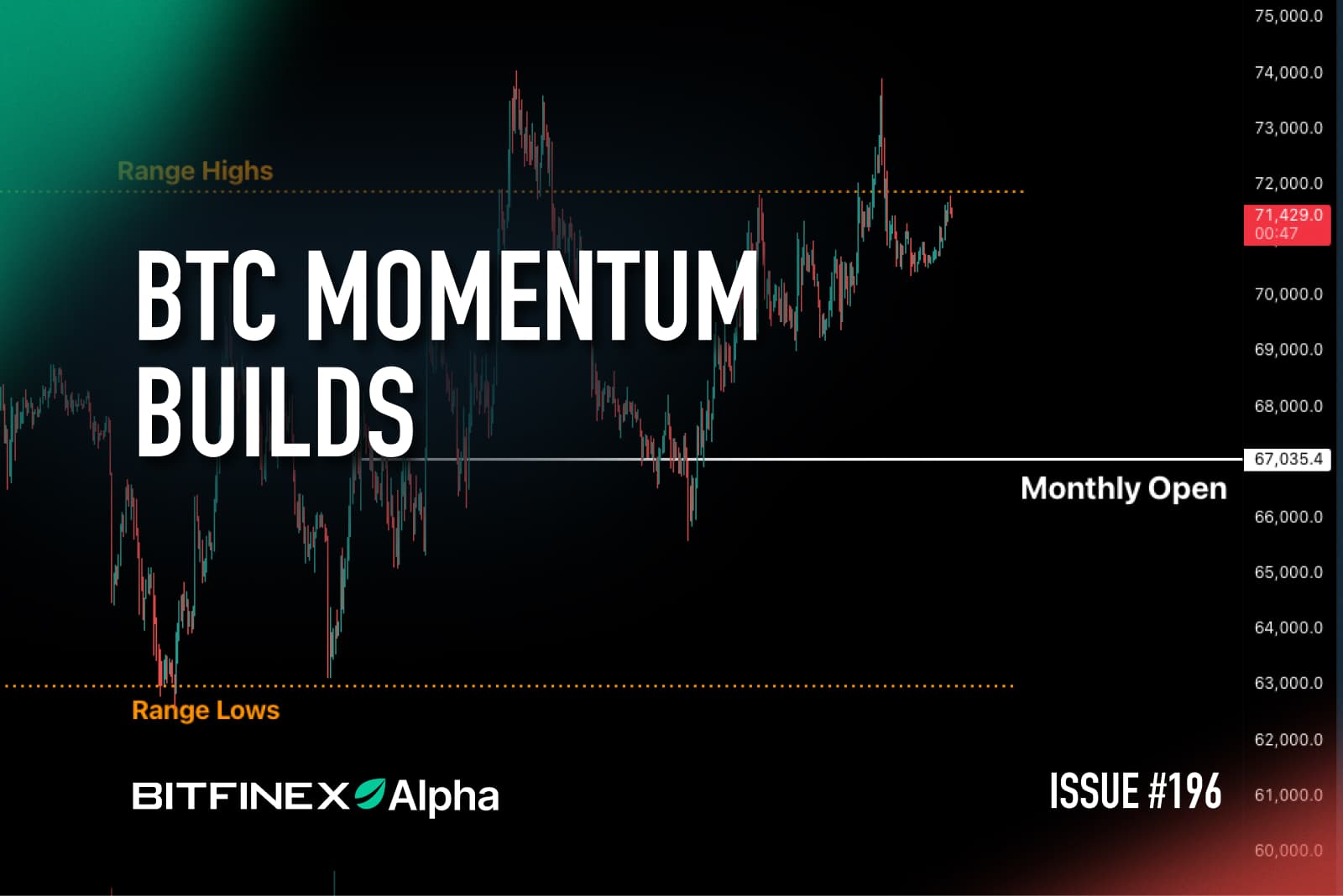
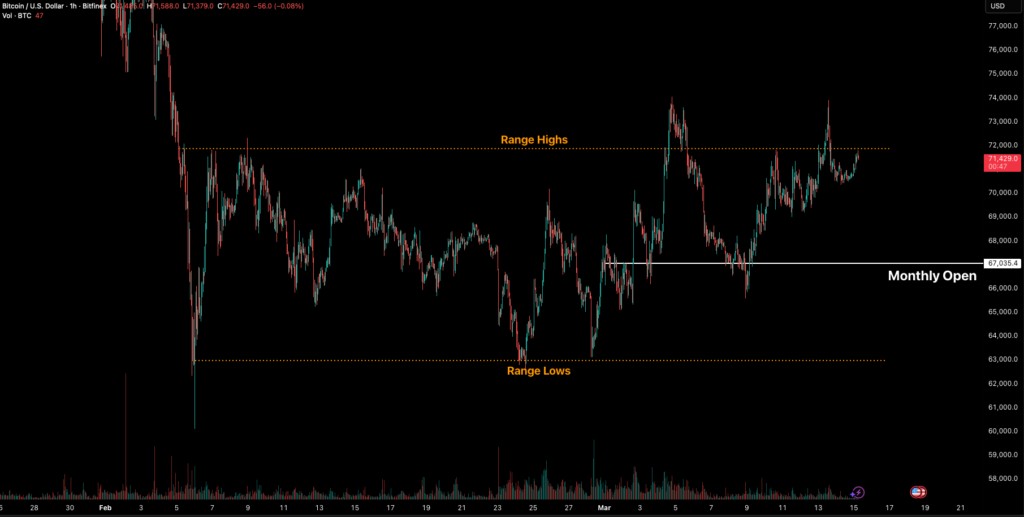
Bitcoin is approaching this week’s FOMC meeting on March 18 with renewed momentum, and has decisively reclaimed the $70,000 level. While price has yet to secure a decisive breakout above local range highs, the underlying structure has improved meaningfully.
Four consecutive sessions of ETF inflows and persistent spot demand signal that institutional buyers are actively accumulating within the range, shifting the narrative from liquidation-driven volatility toward a more constructive absorption phase.
Supporting this shift is the sharp rise in the Bitfinex Absorption-to-Emissions Ratio (AER), which now shows institutional demand absorbing nearly five times the daily miner supply. Combined with neutral funding rates and gradually rebuilding open interest, the market appears structurally healthier than earlier in the year. With a build up in short liquidations clustered near $72,500 – at one point up to $2.4 billion worth – a sustained break above resistance could trigger momentum expansion. For now, Bitcoin remains coiled beneath range highs, but the balance of flows and positioning suggests the market is quietly preparing for its next directional move.
Recent US macroeconomic data suggest that inflation pressures were already building before the latest geopolitical shock in energy markets. February’s Consumer Price Index showed prices rising 0.3 percent month-on-month and 2.4 percent year-on-year, while the core reading reached 2.5 percent. The Federal Reserve’s preferred measure, the Personal Consumption Expenditures (PCE) index, also indicated persistent inflation, with core PCE climbing 0.4 percent on the month and 3.1 percent annually.
Much of this data was collected before the escalation of conflict in the Middle East and the subsequent surge in oil prices, suggesting that inflation may accelerate further as higher energy costs feed into transportation, manufacturing, and consumer goods in the months ahead.
Energy markets are already reacting to these geopolitical developments. In response to rising oil prices and potential supply disruptions, the International Energy Agency announced a coordinated release of strategic reserves among its member nations. However, such increases in supply historically provide only temporary relief relative to global demand.
At the same time, the US housing market is showing mixed signals as it adjusts to the current interest-rate environment. New housing starts rose strongly in January, driven largely by multi-family home construction, but building permits, which signal future supply, declined. Mortgage rates have eased slightly to around 6.58 percent, helping support demand in the resale market, where existing home sales have begun to recover modestly. Nevertheless, high home prices and limited inventory continue to constrain affordability.
These macroeconomic dynamics remain critical for all financial markets, including digital assets. Monetary policy expectations, inflation trends, and geopolitical risks often influence investor behaviour across asset classes. In this environment, attention is increasingly turning to how emerging financial technologies could reshape the broader financial system.
Veteran macro investor Stanley Druckenmiller recently highlighted this shift, arguing that stablecoins and blockchain-based infrastructure could eventually transform global payments. In his view, stablecoins could power a significant share of global payment systems within the next 10-15 years, offering faster settlement, lower transaction costs, and more efficient financial rails compared with traditional banking networks. While Druckenmiller remains sceptical about cryptocurrencies as a store of value, he acknowledged that strong market adoption and network effects have helped sustain their role in financial markets.
Regulation is also evolving alongside these technological developments. A recent report from the US Treasury Department recognised that crypto mixers can serve legitimate financial privacy purposes, even as regulators continue to address their potential use in illicit finance. Meanwhile, the Securities and Exchange Commission (SEC) and the Commodity Futures Trading Commission (CFTC) signalled plans to strengthen coordination on digital asset oversight in an effort to reduce regulatory fragmentation and provide clearer guidance for the rapidly growing crypto industry.
The post appeared first on Bitfinex blog.