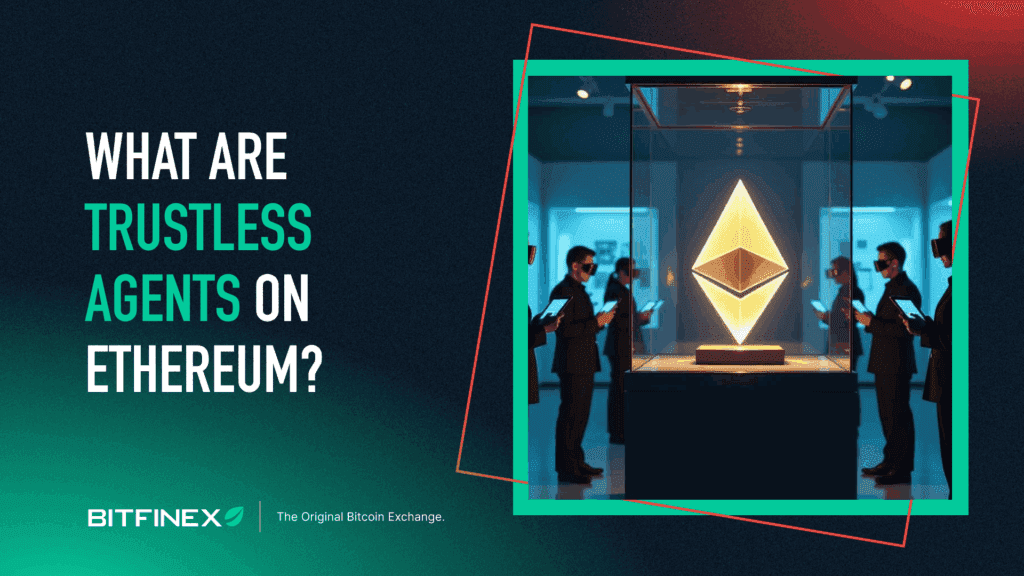
Trustless agents on Ethereum are autonomous software entities that can identify themselves, advertise their capabilities, and interact with users or other agents without requiring pre-existing trust, relying instead on on-chain registries for identity, reputation, and optional external verification to establish reliability and accountability. This framework aims to support an open, interoperable marketplace of agents built by different developers, allowing them to coordinate tasks and provide services across Web3 in a permissionless and transparent manner, potentially expanding Ethereum’s role from a financial settlement layer into a broader coordination network for distributed automation.
What Capabilities Can Trustless Agents Bring to Ethereum?
ERC-8004, a recently proposed Ethereum Improvement Proposal, introduces the concept of Trustless Agents on Ethereum. Trustless agents on Ethereum refer to autonomous or semi-autonomous software agents that can advertise their capabilities, interact with users or other agents, and perform tasks without requiring any pre-existing trust between participants. Instead of operating inside closed platforms or corporate ecosystems, these agents use on-chain registries to establish identity, reputation, and verifiable assurances about their behaviour. The aim is to enable an open marketplace of agents that can be discovered, selected, and coordinated based on transparent and composable trust signals, rather than institutional branding or platform control. This allows agents created by different developers or organisations to interoperate within the same network while maintaining verifiable security guarantees.
The trust framework is organised around three registries deployed on Ethereum or its scaling networks. An Identity Registry assigns each agent a unique on-chain identifier that links to external metadata and service endpoints. A Reputation Registry allows users and other agents to submit feedback after interactions, supporting both simple on-chain scoring and more sophisticated off-chain analysis. A Validation Registry introduces structured verification, enabling independent auditors, stake-backed re-execution, zero-knowledge machine learning proofs (zkML), or trusted hardware attestations to confirm whether an agent performed a task correctly. Together, these components provide a shared infrastructure for discovery, evaluation, and trust formation across agents.
This model could be significant for Ethereum and Web3 because it makes it possible to coordinate services and automation across organisational boundaries, without relying on centralised platforms. Instead of depending on a handful of dominant AI providers, users could choose from a diverse set of agents based on capability, cost, reputation, or cryptographic validation. Developers benefit from shared trust infrastructure rather than building siloed systems from scratch, making agent ecosystems more interoperable and extensible. In this context, Ethereum becomes not only a settlement layer for digital assets, but also a coordination network for AI agent-driven distributed services.
Trustless agents offer the possibility of open agent economies, where both humans and autonomous systems can request work, negotiate terms, and establish trust in a permissionless manner. The protocol supports tasks ranging from everyday low-risk actions to high-stakes operations requiring stronger guarantees, by allowing the trust model to scale with the value at risk. If adopted widely, trustless agents could reduce dependency on centralised intermediaries, encourage competition and specialisation, and expand the scope of decentralised applications well beyond finance into automation, labour coordination, and shared computation. Key challenges ahead include designing robust reputation mechanisms, preventing manipulation, and establishing sustainable incentive structures that promote reliable long-term behaviour.
What Could Web3 Look Like With an Agent Economy?
A Web3 agent economy envisions a digital environment where autonomous software agents, acting on behalf of individuals, organisations, or other agents, can discover services, negotiate terms, and complete tasks without requiring intermediaries. Instead of users manually interacting with protocols, marketplaces, or DApps, agents could handle routine decisions such as searching for the best lending rate, comparing token swaps, updating security configurations, or coordinating payments. These agents would operate in a permissionless environment where identity, trust, and verification are handled through shared blockchain infrastructure rather than proprietary platforms. The result is a shift from user-driven interaction to goal-driven outcomes, where users specify intent and agents execute it across multiple systems.
In such an economy, blockchain networks function as coordination layers rather than just settlement layers. Smart contracts define rules, incentives, and dispute processes, while registries allow agents to prove identity, advertise capabilities, and receive feedback. Trust models could vary by context: everyday tasks may rely on reputation scores, while high-value or high-risk actions could require cryptographic proofs, stake-backed guarantees, or trusted hardware attestations. Importantly, these trust mechanisms would be interoperable rather than siloed, allowing agents developed by different teams to interact reliably. This would encourage a competitive ecosystem where capabilities, not brand ownership, determine which agents are selected for tasks.
For users, an agent-driven web3 could make interacting with decentralised systems more accessible. Instead of navigating complex wallets, protocols, and bridging operations, individuals could delegate actions to personal agents designed to optimise for cost, speed, risk tolerance, or ethical preferences. For businesses, the agent economy could streamline automated supply chains, audits, compliance checks, and data services, all coordinated through shared trust layers. Because these systems are open and composable, smaller developers and organisations could participate without the scaling disadvantages that exist in centralised markets.
The impact could reshape digital labour and economic coordination. Agents could specialise in particular domains, financial routing, data analysis, logistics brokerage, content generation, and then coordinate with one another to complete complex workflows. Economies would no longer rely solely on large platforms to intermediate trust; instead, trust would emerge from cryptography, transparent feedback systems, and verifiable execution. The transition, however, would also introduce challenges, including ensuring fair reputation systems, preventing sybil manipulation, designing incentives that discourage malicious behaviour, and balancing automation with human oversight. If these issues are addressed, a Web3 agent economy could shift the internet from a platform-centric model to an open, interoperable environment defined by freely interacting autonomous services.
How Soon Can We Expect Autonomous Agents in the Ethereum Ecosystem?
The emergence of autonomous agents in the Ethereum ecosystem is already underway, though their widespread adoption will unfold gradually over the next several years. Early agent frameworks exist today in the form of bots, intent-based transaction systems, MEV searchers, automated trading strategies, and smart-contract–driven scheduling tools. However, these systems are narrowly scoped and lack general-purpose reasoning, discovery, and trust frameworks needed for agents to interact openly across applications. Recent developments in on-chain identity standards, agent registries, and AI model interfaces signal that the underlying foundation for more capable, interoperable agents is being actively built, but is still in its early stages.
Short-term progress (over the next 12–24 months) is likely to focus on personal and organisational “helper agents” that execute routine tasks under explicit user permission. These agents may manage token transfers, monitor risk thresholds, rebalance liquidity positions, or negotiate trades across decentralised exchanges. Because the consequences are relatively contained and tasks are well-defined, these early agent systems do not require strong on-chain trust guarantees beyond signatures and auditability. Rather than fully autonomous behaviour, we will see semi-automated agents that augment user decision-making while preserving human oversight.
More advanced agent economies, where agents discover, evaluate, and coordinate with other agents in untrusted environments, will depend on the establishment of shared trust frameworks. Proposed Ethereum standards for agent identity, reputation registries, and cryptoeconomic validation are attempting to address this gap by enabling agents built by different parties to verify each other’s performance history and reliability. The maturity of these systems will also depend on improvements in compute infrastructure, including zkML proofs, secure enclaves, and scalable rollups capable of hosting agent reasoning and inference workloads. Realistically, robust cross-organisational autonomous agent markets may take three to five years to meaningfully develop.
The long-term transition is likely to be evolutionary rather than abrupt. As smart contract platforms become more modular, intent-based architectures become normalised, and AI inference becomes cheaper to verify, agents will shift from optional conveniences to default interaction patterns. Users may no longer sign every transaction manually; instead, they may set preference boundaries and allow agents to act on their behalf across DeFi, social applications, and coordination networks. The trajectory suggests that autonomous agents will not replace human decision-making, but will increasingly serve as intermediaries that translate human intent into complex, multi-step on-chain actions. In this sense, the question is less about “if” autonomous agents will become central to Ethereum, and more about how smoothly and securely this transition can be governed.
The post appeared first on Bitfinex blog.