The Kraken Institutional Forum was a closed-door gathering designed not for headlines, but for substance: a space where clients, prospects, and Kraken leadership could get into the details of where institutional crypto is heading and what it takes to get there.
Here’s a look at what was covered and why the conversations that took place will shape how institutions engage with this market in the months ahead.
Setting the scene
The afternoon opened with welcome remarks from Gurpreet Oberoi, Head of Kraken Institutional, who set the tone by framing the day around a simple but consequential question: what does it actually take to build institutional-grade infrastructure for digital assets, and who is positioned to deliver it?
His answer, and a theme that echoed throughout the day, was that the institutions that win in this market will be vertically integrated platforms that seize the momentum. Gurpreet drew a direct parallel to the stablecoin moment five years ago: just as people once questioned why anyone would want a digital dollar, the questions being asked about institutional crypto today will look equally short-sighted in hindsight. From tokenized equities to sophisticated trading strategies, the multi-trillion asset-class is just getting started.
A fireside with Kraken Co-CEO Dave Ripley
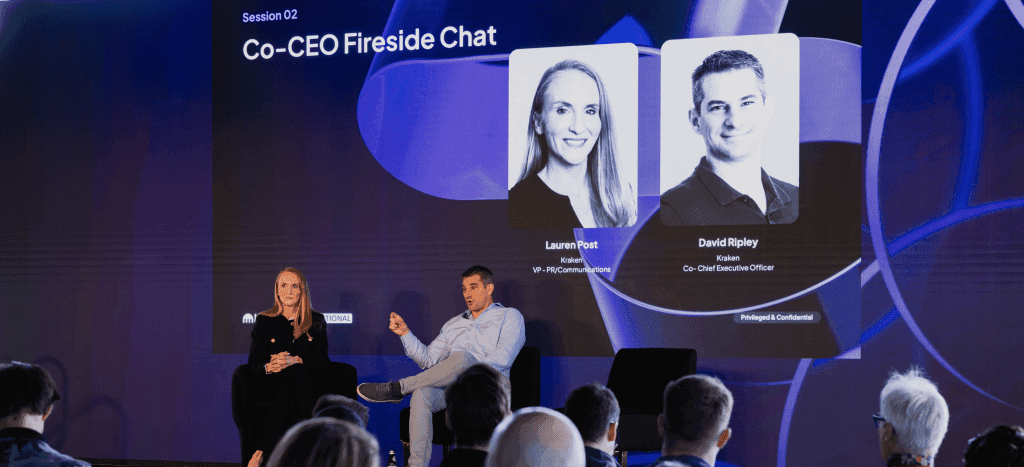
Following the opening remarks, Dave Ripley sat down with Lauren Post for a wide-ranging fireside conversation that set the intellectual backdrop for the rest of the afternoon.
Dave opened by taking the room through Kraken’s 14-year journey across crypto’s most turbulent market cycles, framing each one not as a setback but as a formative lesson. Security came first: Kraken was born directly out of the Mt. Gox hacks of 2012 and 2013, with co-founder Jesse Powell’s response to those breaches becoming the founding philosophy of the platform.
Financial discipline came next, forged through the cold bear market of 2015 and reinforced sharply in 2021, when Kraken watched peers like Voyager, Celsius, and FTX chase growth without guardrails. Scalability was the lesson of 2017, when a 1,000x surge in throughput forced a full rewrite of the matching engine mid-cycle. And through the 2023 bear market, as banking partners disappeared and competitors exited markets, Kraken’s foundations held: a testament to the financial discipline and operational resilience built up over the previous decade.
The thread running through all of it, Dave argued, is a culture of being what Kraken calls “productively paranoid.” Security, financial risk, and regulatory compliance aren’t functions sitting in a corner of the business: they’re embedded into every team, every decision, and every product.
On institutional adoption, Dave was direct: for the first time in a decade of hearing “institutions are coming,” he genuinely believes it. The progression has been gradual. Venture capital first, then high-frequency trading firms, then isolated macro investors like Paul Tudor Jones and Stan Druckenmiller, then the ETF wave.
But 2026 feels different. Major banks and brokers have spent the last 12 months actually integrating crypto into their platforms, and Dave expects many of them to go live this year. The infrastructure is ready, the appetite is there, and the direction of travel is clear.
On tokenization, he pointed to xStocks, already the highest-volume tokenized equity product in the market, as proof that the stablecoin playbook is repeating itself. People once asked why anyone would want a digital dollar. They now ask why anyone would want a tokenized stock. In both cases, the answer becomes obvious in hindsight. Tokenized metals, private credit, and private equity are next, and the infrastructure to support them is being built now.
A view across the institutional ecosystem
Early in the afternoon, Gurpreet Oberoi moderated a panel discussion featuring Gordon Grant of Bitwise and Chris Perkins of CoinFund: two of the most experienced operators at the intersection of traditional finance and digital assets.

The conversation was wide-ranging and candid. On the state of the market, Chris pushed back on bearish sentiment directly: retail has been burned, but institutions are marching forward, driven by material regulatory unlocks and fundamental improvements across the board.
His view, that this is a generational entry point, was grounded in a simple observation: the macro stress of recent months saw capital flow into gold rather than Bitcoin not because the Bitcoin thesis had changed, but because the majority of allocators are still familiarizing themselves with the asset class. That’s a timing issue, not a structural one. The institutions are coming, and when retail returns, they’ll be joined by a third demographic: agents.
Gordon brought a derivatives lens to the same question. The infrastructure picture has changed fundamentally. You now have OTC Bitcoin derivatives, options on spot ETFs, options on CME futures, and Bitcoin increasingly accepted as collateral. Before long, that entire ecosystem will be viewed as a single market with over $150 billion in daily liquidity across spot, futures, and options, available 24/7. The institutions that recognize this earliest will have a meaningful advantage.
On derivatives specifically, both panellists were emphatic: derivatives run markets, and crypto’s derivatives market is still dramatically underdeveloped relative to where it needs to be. Options currently represent a fraction of total crypto volumes; within two years, that should shift materially. Chris was clear that whoever wins the derivatives market wins the broader market: single-token futures, perps, and basis trading strategies will be the engine of the next phase of institutional growth.
Five conversations that defined the day
Will institutional crypto always just be BTC and ETH?
Gurpreet Oberoi led a candid roundtable on capital concentration. BTC and ETH will remain dominant for now, but the structural conditions for institutions to move meaningfully into the broader market are developing fast. As they do, counterparty quality becomes as important as asset selection.
Kraken’s approach of not taking on principal risk and operating as a trusted, regulated counterparty is increasingly what institutions demand as they scale, with the ability to support both large-cap strategies and emerging token ecosystems within a single, resilient platform.
How do we get to peak tokenization?
Pier Procacci, Head of Institutional Product, facilitated what may have been the day’s most forward-looking discussion. The room was aligned on one important shift: tokenization has moved decisively past the exploration and hype phase. The conversation is no longer about whether it’s possible, but how to execute and scale.
Oracle infrastructure, secondary liquidity, and custody solutions all need to keep pace, and Kraken’s integrated approach positions it as one of the few platforms where this vision is already becoming operational.
The next 12 months in yield solutions
Jonathan Marcus, Head of Staking, and Olivier Mammet, Head of OTC, led a session on a question that is front of mind for most institutional allocators: how do you make digital asset capital work harder?
A model gaining real traction is using a qualified custodian like Kraken as the connective tissue, linking institutions directly to a top-tier asset manager like Bitwise for yield, while using cross-margin positions as collateral to maximize capital efficiency. The vision is a genuine one-stop shop: custody, yield, and financing under one roof.
Breaking down the barriers between crypto and TradFi
Jack Finio led a roundtable on the infrastructure gap that still slows capital movement between crypto and traditional markets. Tri-party collateral arrangements generated the most interest: specifically, the ability to use traditional assets held with conventional custodians as collateral for crypto positions, allowing institutions to access crypto markets without moving capital into a new silo. It’s a meaningful unlock, and one that sits squarely within Kraken’s convergence thesis.
Trading volatility in an uncertain world
CF Benchmarks’ Gabriel Selby and Xin Wang led a session that felt particularly timely given the macroeconomic backdrop. Institutional demand for Bitcoin vol exposure is clicking into high gear as banks begin offering more structured products, and the conversation reflected that shift in real time.
A theme that emerged strongly was the change in how market participants are approaching volatility itself: amid the turbulence of 2026, institutions are increasingly assessing and managing vol in a more deliberate and disciplined way, moving beyond using it purely as a hedging tool and towards treating it as an asset class in its own right, with dedicated strategies designed to monetize it systematically.
Closing remarks
Kraken Co-CEO David Ripley closed the forum by reflecting on a journey that started, in his words, with the belief that TradFi and crypto would never meet. He was, as he put it, “completely fucking wrong.” The future isn’t decentralized over here and centralized over there. It’s a hybrid of the two, and the companies that understand both sides are the ones that will define what this market becomes.
His message to everyone in the room: Kraken isn’t building for the current moment. It’s building for the institution that wants a long-term partner as this asset class reaches its next phase of maturity: fully integrated, vertically consolidated, and already operating at a scale that most of the industry is only beginning to target.
Interested in learning more about what Kraken Institutional offers?
The post appeared first on Kraken Blog.