Fed Chairman Jerome Powell is likely chairing his final Federal Open Market Committee (FOMC) meeting on 29 April. Fed Funds futures pricing suggests the federal funds rate will be held at 3.5-3.75 percent, the third consecutive pause of the year. The decision has been fully priced in for some weeks, since inflationary concerns drifted higher following rising geopolitical tensions and the blockade of the Strait of Hormuz, both of which have put upward pressure on oil prices. Prediction markets have also converged on a 99.7 percent probability of a hold entering the week.
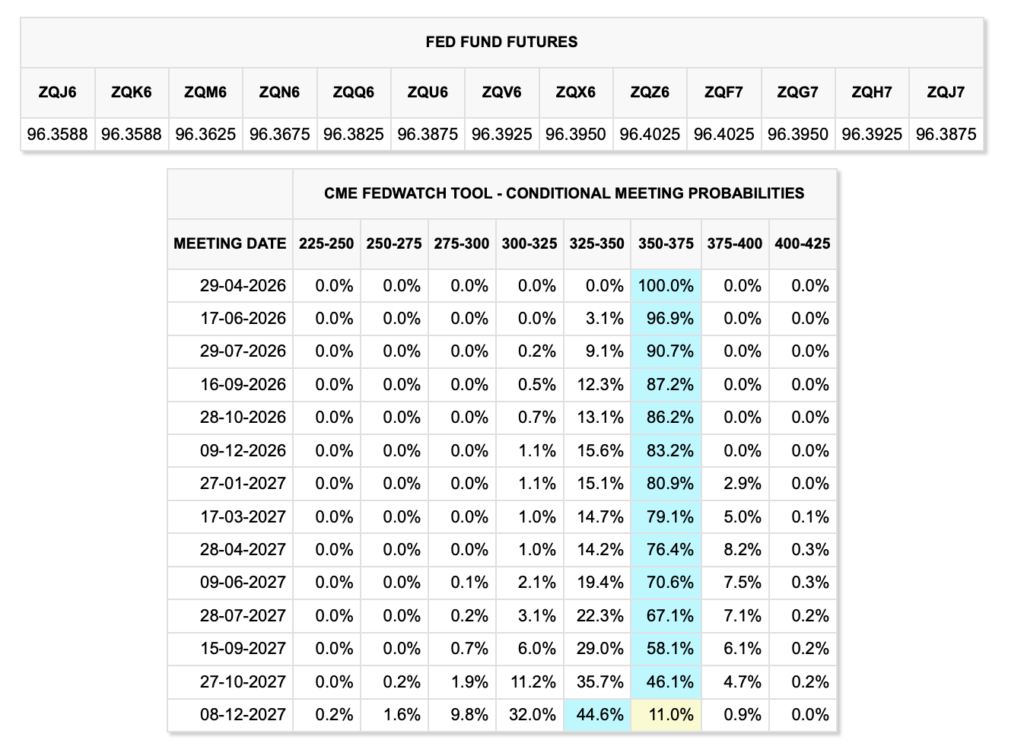
For this meeting, the real signal sits in the statement language. Previously, the FOMC acknowledged that “implications of developments in the Middle East for the US economy are uncertain” and described the inflation overshoot driven by energy prices as a risk warranting attention, rather than a transitory event. The key phrase, “attentive to the risks to both sides of its dual mandate”, offers a balanced framing that rules out both hawkish escalation and a dovish pivot in the near term.
The March Consumer Price Index (CPI) printed at 3.3 percent year-on-year, the highest reading since May 2024 and a full 130 basis points above the Fed’s two percent target. With Brent still trading above $100 and Hormuz seizures not broadly resolved, the pass-through risk into April CPI is concrete. Powell has also not declared that this form of inflationary pressure is transitory. This is key as it demonstrates that the confirmation trigger in our active thesis, namely energy inflation being declared transitory by the FOMC, has still not been met.
A significant dimension of this meeting is also the transfer of the Fed reins to Kevin Warsh, who from 15 May, will assume the Chair of the Federal Reserve Board. Warsh is rules-based and hawkish-leaning by disposition. The April statement provides him with an ambiguous inheritance: inflation above target, energy risks live, no dot plot to anchor the forward path, and a non-Summary of Economic Projections (SEP) meeting in which no updated projections were published. The H2 2026 rate cut path that options markets are partially discounting was priced under a Powell-led committee. That committee no longer exists after today.
Options Market Positioning is Key
The most underappreciated signal this week does not sit in on-chain data or exchange-traded fund (ETF) flows: it’s the options market. The Bitcoin Volatility Index (BVIV), the 30-day implied volatility (IV) measure, has retreated to approximately 42 percent, its lowest reading in three months. The January-to-February 2026 peak registered approximately 56 percent, coinciding with the market’s deepest drawdown of the year.
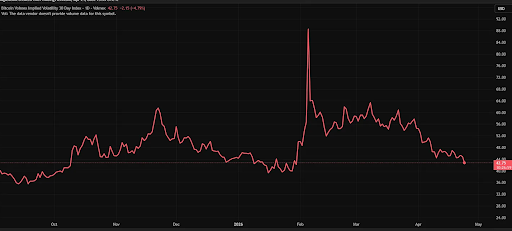
Despite the steep decline in IV, the risk premium has remained positive throughout. IV traded at a premium to realised volatility (RV) for most of April before converging recently. This implies that demand for protection into a macro event such as the FOMC has been dominated by end-of-month options flows, with limited interest in paying premium for downside protection closer to expiry.
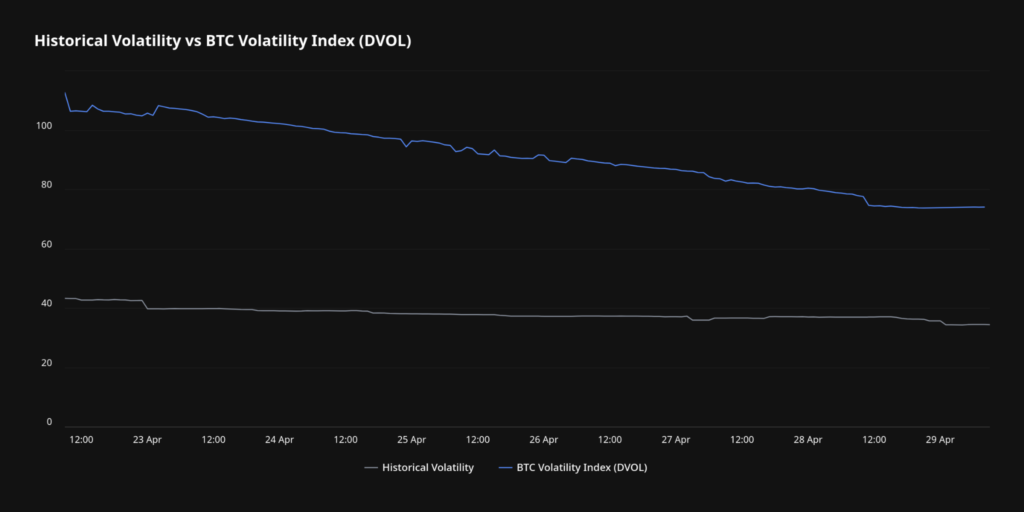
The decline carries a specific structural signature. It occurred alongside a six percent drop in open interest (OI) over 24 hours, meaning market participants are reducing exposure rather than hedging it. When IV falls and OI falls together, the signal is de-risking conviction, not complacency. The IV Rank of 25.15 confirms this: at the 25th percentile of its recent range, near-term options are cheap relative to recent history.
The term structure adds a layer of precision. Front-end skew is neutral. The market is not paying a premium for downside protection in the one-to-two week window. The back-end protection bid remains in place, with institutional participants still buying tail-risk cover on longer-dated tenors. This structure reflects a rational response to the Warsh transition: the near-term FOMC event is fully priced, but the six-to-twelve month policy path under new leadership is not.
The combination of compressed IV and 26 consecutive days of negative funding has created a structural asymmetry. Short positioning is crowded. Options are cheap. The True Market Mean (TMM) at $78,400 has been reclaimed. If spot acceptance above $80,100, the Short-Term Holder Realised Price, materialises with conviction, the cost of being short at that level is high, and the options market is not pricing that scenario appropriately. Calls are structurally underpriced relative to the positioning setup.
For historical context, on 5 February 2026 the 25-delta risk reversal fell to -19.34, the deepest put preference since 2022 and the fear-capitulation low of this drawdown cycle. The recovery since that extreme confirms the market is no longer hedging for collapse. It is positioning for range. The question going into the 48-hour post-FOMC window is whether IV compresses further or expands as the decision is absorbed.
Bitcoin Dominance: Post-Contagion Capital Rotation
Bitcoin dominance has undergone a structural transformation over the last two years, a trend originating from the conclusion of the prior market cycle in 2022.
In the current cycle, characterised by institutional-driven liquidity flows concentrated around bitcoin, the Bitcoin Dominance metric (BTC.D) climbed from a low of 39.6 percent during the altcoin mania phase of the previous cycle in 2022. It peaked at 65 percent in June 2025 before consolidating in the 56 to 59 percent range in early 2026. More recently, the figure has staged a fresh breakout, reaching 60.63 percent in late April 2026. This sustained increase since the previous cycle’s peak speculation in alternative cryptocurrencies signals a maturing market focus.
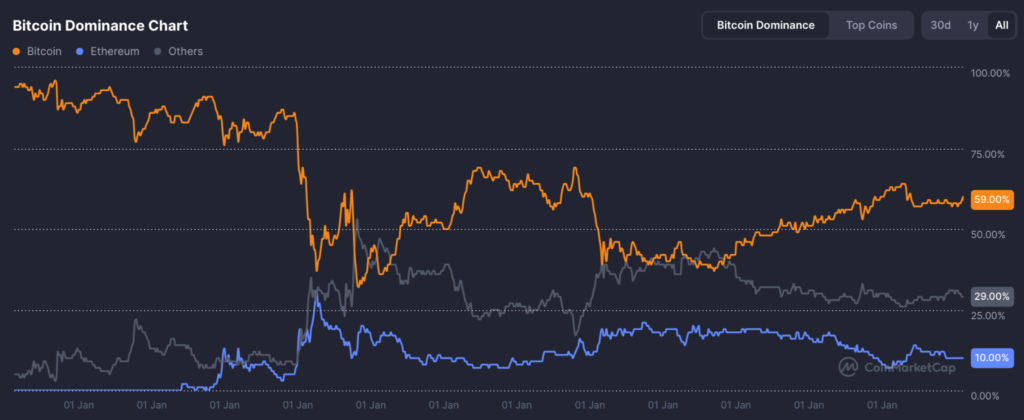
During periods of heightened macro and geopolitical uncertainty, bitcoin has consistently demonstrated leadership over both major equity indices and the broader altcoin market. This reinforces its utility as a macro-inflationary hedge, even as it has recently underperformed traditional safe-haven assets such as gold in its role as a monetary-inflation hedge.
The dominance rise through this environment is not a narrative signal. It reflects a mechanistic rotation. Capital exiting compromised DeFi protocols and liquid restaking structures is not leaving the cryptocurrency market. It is consolidating into bitcoin. This is institutional behaviour. The same customer profile that drives ETF flows operates the risk-off rotation within digital assets. Dominance at 60.63 percent, with no altcoin rotation visible, confirms that the demand base is concentrated in bitcoin specifically.

The post appeared first on Bitfinex blog.