
While the late-2025 rally in privacy coins like Zcash (ZEC) and Monero (XMR) has since cooled, demand for anonymous, permissionless digital money — the cypherpunk vision that motivated early Bitcoiners — is unlikely to change.
What has changed is where privacy innovation is being directed.
Rather than existing primarily as standalone coins and separate networks, privacy is increasingly being explored as infrastructure: confidentiality embedded directly into high-liquidity public blockchains, paired with selective disclosure mechanisms intended to withstand regulatory scrutiny.
The recent launch of Arcium’s Mainnet Alpha on Solana, with Umbra deploying as its first application, is one signal of that broader shift — not because either of them necessarily “solves” privacy but because they reflect where attention is moving.
From Standalone Privacy to Composable Confidentiality
For most of crypto’s first decade, privacy largely meant privacy coins: purpose-built networks designed to make base-layer activity harder to surveil. That model still matters, particularly for users who want privacy by default and outside of institutional frameworks.
Market structure, however, has changed. Liquidity, applications and day-to-day workflows have become increasingly concentrated on a small number of major L1s. As a result, privacy innovation is being pulled toward where capital, users and integrations already exist.

This is the premise behind so-called “privacy layers”: instead of asking users to migrate to separate ecosystems with thinner liquidity and fewer integrations, the goal becomes adding confidentiality inside existing networks — ideally without breaking composability and in forms that can survive contact with regulated rails.
Arcium and Umbra are timely examples of this approach on Solana. Arcium positions itself as a confidential computation network — an “encrypted supercomputer” — intended to let applications process sensitive data without placing that data directly onto the public ledger, while still returning verifiable outcomes to the main chain. Umbra, positioned as a “shielded financial layer,” is an early application building on top of that infrastructure, with an initial focus on shielded transfers and encrypted swaps.
Umbra’s key commercial framing is selective disclosure: privacy by default, with a mechanism to reveal relevant details to an auditor, counterparty, or authority where legally required.
The point is not that these launches represent an endpoint for privacy. It is that they illustrate how the category is being redefined — away from isolated privacy venues and toward confidentiality expressed as infrastructure inside major ecosystems.
Two Privacy Primitives, Two Very Different Goals
Once privacy moves into the main venues, precision matters. Not all “privacy layers” are attempting the same thing.
Confidential transactions are a narrow approach focused on hiding values (and sometimes asset details) while still allowing the network to validate that rules were followed. They map cleanly to settlement: moving value without broadcasting amounts to the market. Because the scope is constrained, there is typically less that can go wrong — and it’s easier to be precise about what is and isn’t protected.
The Liquid Network’s Confidential Transactions are a prime example on Bitcoin: settlement-first privacy with a deliberately bounded design that has operated for years without attracting regulatory scrutiny.
Confidential computation, as employed by Arcium, targets a broader problem. Rather than just hiding amounts, it aims to keep sensitive inputs and intermediate application state private while still producing correct, verifiable outcomes. In practice, this is private smart-contract-style execution — logic that runs without revealing commercially sensitive data.
Framed by Arcium as a step toward “encrypted capital markets,” the institutional angle is fairly straightforward: not simply hiding balances, but enabling commercially-sensitive strategies and execution to run without broadcasting intent to the entire market, while outcomes still settle on a public chain.
That ambition also introduces more complexity — and more trade-offs.
The Trust Trade-Offs Behind Confidential Computation
Once systems move from hiding values to hiding execution, the central design question becomes simple: what are you willing to trust, and where does failure concentrate?
Arcium’s approach is MPC-based. Multi-party computation splits sensitive data into cryptographic “shares” across operators so no single party sees the full input. Privacy breaks only if enough operators collude (or are compromised) to reconstruct the underlying data.
TEE-based designs, such as those associated with Secret Network, a privacy layer on Cosmos, push the trust boundary into hardware enclaves: operators may not see plaintext, but confidentiality now depends on enclave security and the hardware supply chain.
Different designs trade off performance, trust assumptions, decentralisation and integration — and those trade-offs become central once you start talking about confidential execution rather than just confidential settlement.
Regulation as the Forcing Function
This is also where the “regulator-tolerable” bet becomes real.
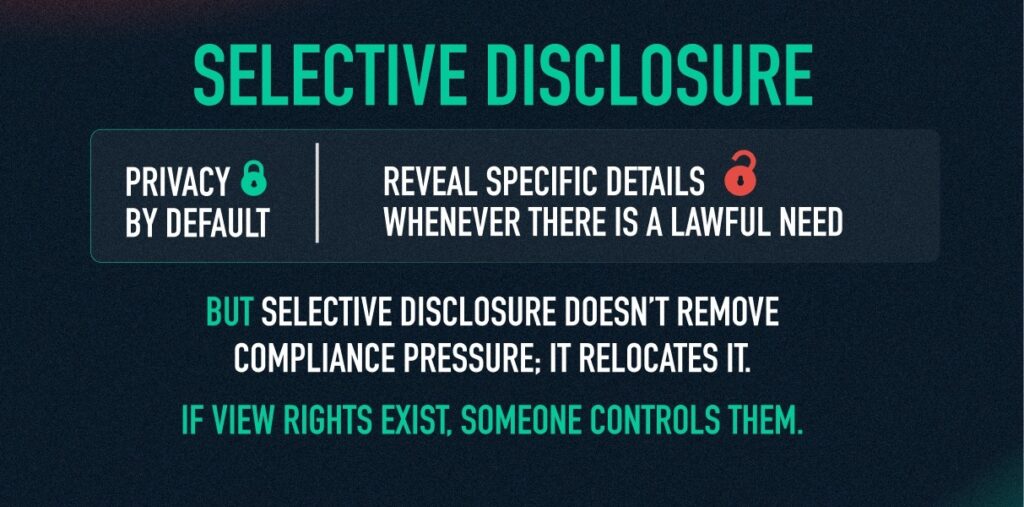
Selective disclosure is one of the most intriguing elements of the new privacy narrative. The pitch is simple: privacy by default, with the ability to reveal specific details whenever there is a lawful need. But selective disclosure doesn’t remove compliance pressure; it relocates it. If view rights exist, someone controls them. The hard questions are operational and legal — who can grant disclosure, who can be compelled to grant it, and where liability sits when disclosure is demanded or refused.
Different designs push responsibility onto different actors — the user, developers, infrastructure operators, or intermediaries — and each choice creates a different enforcement surface.
That’s why “regulator-tolerable” is best treated as an open hypothesis rather than a settled outcome. The market is not only testing cryptography; it is testing governance and incentives under real pressure.
No discussion of privacy infrastructure is complete without acknowledging Tornado Cash, because it illustrates how privacy tools can become enforcement flashpoints with consequences that outlast any single legal event. The mechanism is not only deterrence. It is ecosystem constriction: front ends, integrators, custodians and service providers disengage, participation shrinks, and the practical properties privacy systems depend on weaken.
Something can remain technically functional while becoming commercially unusable once the surrounding ecosystem becomes risk-averse.
In Europe, the Anti-Money Laundering Regulation (AMLR), set to come into force in 2027, adds a concrete timeline around anonymous wallets and “anonymity-enhancing” instruments for regulated providers. The unresolved issue is how broadly those concepts will be applied, and whether app-layer confidentiality infrastructure will be treated as distinct from mixer-style tools or privacy coins once regulators focus on outcomes rather than architectural nuance.

The implicit bet behind privacy infrastructure is that confidentiality framed as market structure, paired with workable auditability pathways, will be treated differently from tools perceived primarily as obfuscation. Whether that distinction holds will depend less on technical sophistication and more on real-world outcomes: how systems are used, where enforcement leverage can be applied and whether disclosure mechanisms function under pressure.
The Ultimate Test
If privacy is moving from an asset category to an embedded capability, the next phase will come down to a few practical tests.
Adoption matters because privacy is partly statistical. If only a thin slice of activity uses confidential rails, usage stands out and protection weakens. Composability matters because DeFi assumes transparent state; confidential execution has to coexist with pricing, analytics, liquidations and risk monitoring, or it remains a niche side pocket. And selective disclosure matters because it will be judged under real audits and enforcement pressure: too weak and regulated rails step back; too strong or too centralised and it recreates the choke points privacy systems were meant to avoid.
Arcium and Umbra are just two parts of an evolving story in which privacy is being pulled toward the chains where liquidity already exists, and increasingly framed as an attempt to make confidentiality compatible with compliance.
Whether that compromise holds — technically, economically and legally — is the ultimate test.
The post appeared first on Bitfinex blog.