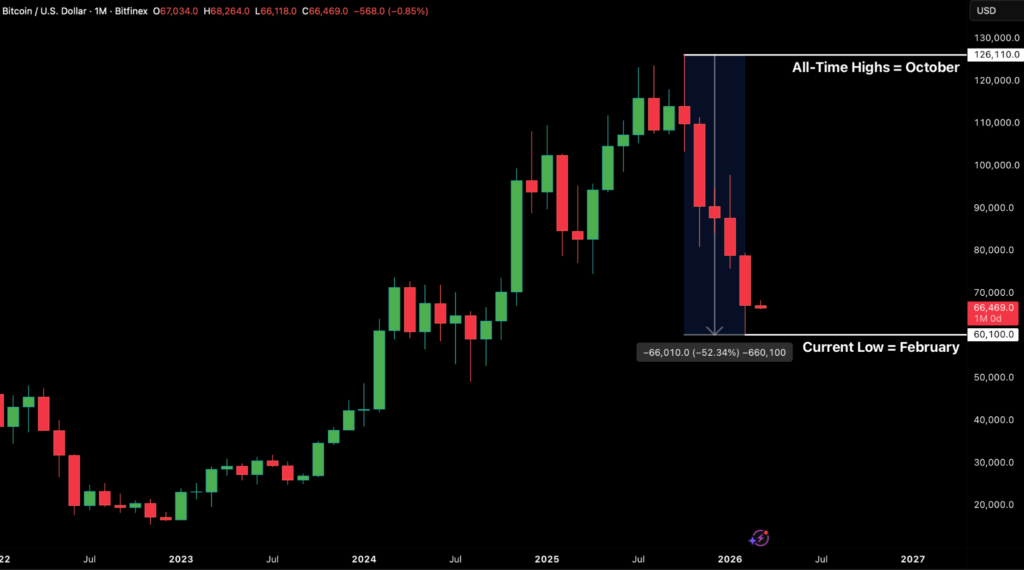
Derivatives positioning confirms a comprehensive leverage reset. Futures open interest has fallen by more than 50 percent from its October peak, while funding rates briefly plunged deeply negative following the Iran escalation, signalling a sentiment trough and short-heavy positioning. Historically, such extremes create the conditions for reflexive squeezes if spot demand follows through. The options market, however, presents a nuanced picture: near-term skew remains defensive, with strong demand for downside protection, while quarterly positioning into late March shows a pronounced call bias clustered around $80,000–$90,000.
Recently, policy developments across macroeconomics and digital assets have resulted in cautious markets, but we do not see any systemic instability in either arena. The US administration’s decision to impose a 10-15 percent global tariff under Section 122 of the Trade Act of 1974, following the Supreme Court’s invalidation of earlier measures, has introduced short-term trade unpredictability. However, this section is intended to be invoked in the case of a balance-of-payments crisis, and the legal threshold for this does not appear to be met. The US dollar retains its reserve status, Treasury markets remain liquid, and capital inflows continue to finance trade deficits. Markets are therefore treating the tariffs as temporary.
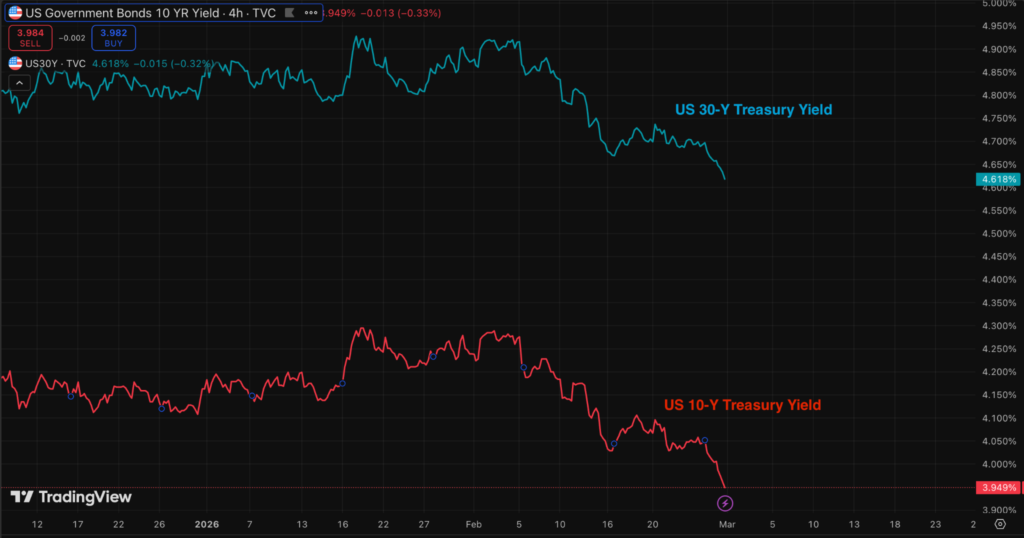
Financial conditions reinforce this interpretation. Long-term Treasury yields have declined amid defensive positioning, reflecting a flight to safety driven by trade uncertainty and geopolitical risk. Equity markets have reacted modestly, while gold has appreciated. These movements suggest risk management rather than broad-based stress. At the same time, producer price data show renewed inflationary pressure, with upstream costs accelerating and services inflation remaining firm. Construction spending has stabilised in parts of the residential housing sector but remains uneven overall. Together, these signals reduce the likelihood of near-term Federal Reserve rate cuts and point to a continued restrictive stance.
Escalating conflict in the Middle East has added to energy market volatility. Direct US and Israeli operations against Iran have heightened concerns over potential disruption to the Strait of Hormuz. While oil prices could spike in the near term, structural supply buffers reduce the risk of a sustained shock. Floating storage remains elevated, global liquids production exceeds 100 million barrels per day, and prior conflicts show that price surges often reverse once hostilities ease. Federal Reserve Bank of Dallas modelling suggests even a temporary closure scenario would likely push prices higher briefly before moderating as supply adjusts.
In the cryptocurrency sector, governance and enforcement pressures are intensifying. A proposal by Mt. Gox’s former CEO to introduce a Bitcoin hard fork to recover nearly 80,000 BTC from the 2011 hack has reopened debate over immutability and protocol governance. While framed as a narrow exception, such a change would test the principle that ownership is defined solely by private key control. Meanwhile, US authorities have frozen over $580 million in crypto linked to transnational fraud networks, highlighting expanding cross-border enforcement capabilities. At the state level, Minnesota lawmakers are considering banning crypto kiosks entirely after persistent fraud cases, signalling a tougher stance on physical cash-to-crypto infrastructure.
The post appeared first on Bitfinex blog.