Review full report Subscribe to Bitfinex Alpha Subscribe
to Bitfinex Alpha! Want to receive Alpha from Bitfinex every week? Subscribe if (document.cookie.indexOf('sticky-note-subscribe=1') === -1) { document.querySelector('#sticky-note-subscribe').style.display = 'block' } document.querySelector('#sticky-note-subscribe-cta').addEventListener('click', (e) => { e.preventDefault(); document.querySelector('#sticky-note-subscribe').style.display = 'none' document.cookie = 'sticky-note-subscribe=1; max-age=7776000'; }); .wp-block-buttons > .wp-block-button { flex: 1; } .wp-block-buttons .wp-block-button .wp-block-button__link { display: block; text-align: center; } .wp-block-buttons .wp-block-button:last-child .wp-block-button__link { background-color: #1ABC91; border-color: #1abc9c; color: #fff; }
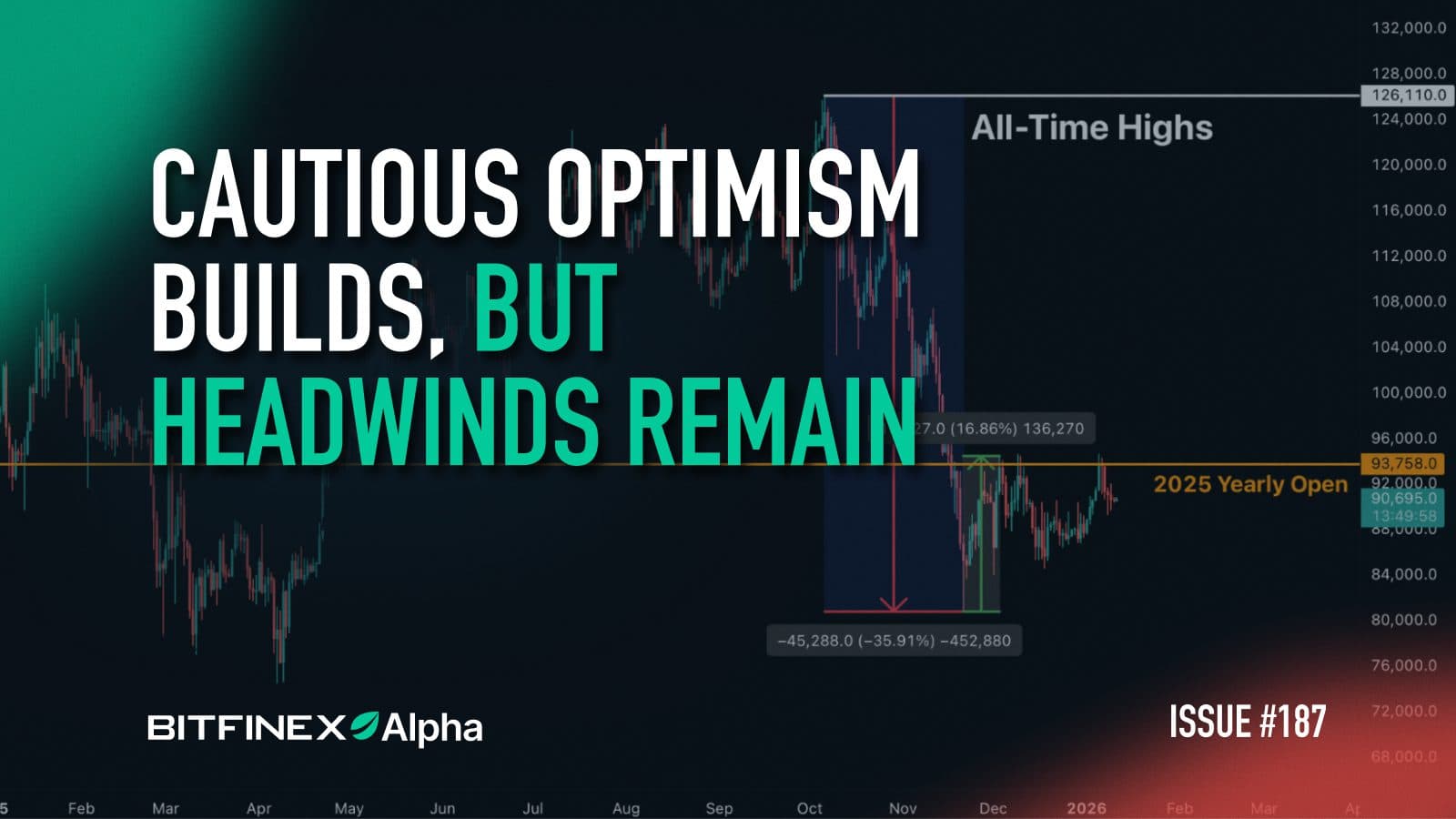
Bitcoin continues to test the key $93,500–$95,000 resistance zone following its rebound from the late-November low near $80,800.
While the medium-term outlook for 2026 remains constructive amid expectations of improving global liquidity, near-term price action is still capped by geopolitical uncertainty, mixed ETF flows, and the need for a clear acceptance above this resistance band to shift market structure decisively higher.
The sharp year-end reset in options open interest has cleared legacy positioning, leaving a cleaner derivatives landscape that reflects cautious optimism: longer-dated upside positioning alongside near-term downside hedging, and implied volatility remaining compressed but gradually firming.

At the same time, Bitcoin is now advancing into a dense supply zone defined by recent top buyers, whose cost basis spans roughly $92,100 to $117,400. As price revisits this area, breakeven selling pressure is likely to increase, as holders who endured the drawdown look to exit without losses. This creates meaningful overhead resistance and suggests that further upside will require time and sustained spot demand to absorb distribution. Until this supply is worked through, the market is likely to remain range-bound, with risk appetite rebuilding gradually rather than transitioning immediately into a renewed impulsive uptrend.
Recent US macro data point to an economy that is slowing in activity but not yet slipping into outright weakness, with growth increasingly shaped by productivity and trade dynamics rather than labour expansion.

The labour market is showing a clear hiring pause, as job creation has slowed markedly while unemployment remains low, reflecting a “slow hire, no fire” environment in which firms retain workers but avoid adding headcount. Rising productivity is allowing businesses to sustain output and margins with fewer hours worked, reinforcing expectations that the Federal Reserve will keep rates unchanged in the near term while remaining cautious about easing later in the year.
At the same time, the US trade deficit has narrowed sharply, driven largely by falling imports rather than broad-based strength in domestic demand, even as exports reached record levels. While the improved trade balance may support headline growth in the short run, the underlying drivers point to softer consumption, risks to transport and logistics employment, and potential pressure on small businesses, suggesting that economic momentum is becoming more uneven beneath the surface.
Across major economies, digital assets are moving decisively toward integration with established financial systems, marking a shift from fragmented crypto markets to institutionally governed infrastructure. In Japan, policymakers have signalled 2026 as a strategic inflection point, with plans to route cryptocurrency trading through regulated exchanges, align major tokens with securities-style oversight, and introduce a flat capital gains tax to support wider retail and institutional participation. This regulatory convergence is echoed in the United States, where a politically connected crypto venture has sought a national trust bank charter to internalise stablecoin issuance and custody under federal supervision, underscoring how stablecoins are increasingly intersecting with core banking functions despite heightened scrutiny. Taken together, these developments reflect a broader global transition toward regulatory clarity, exchange-based access, and institutional frameworks as the foundation for the next phase of digital asset adoption.
The post appeared first on Bitfinex blog.