TL;DR
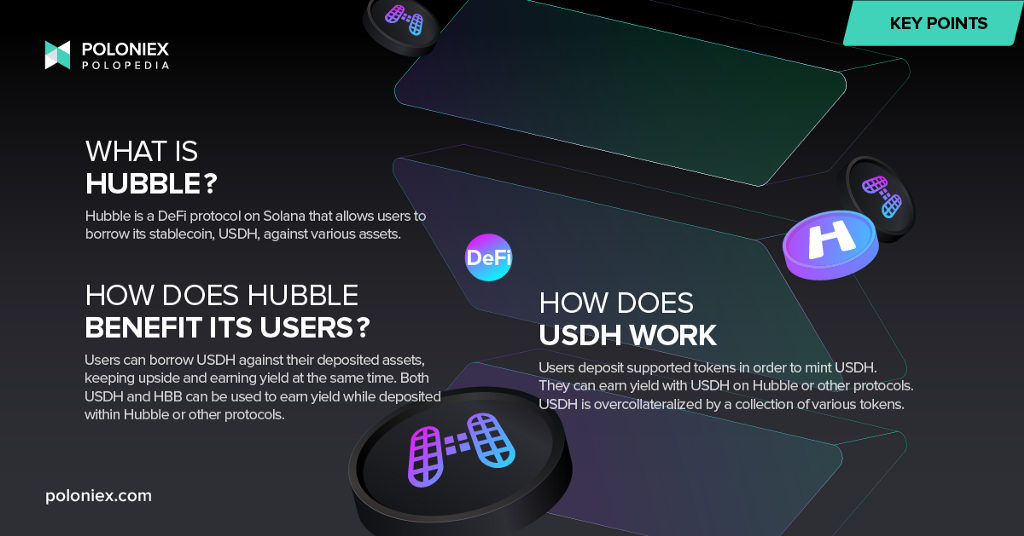
Hubble is a DeFi protocol built on Solana. Its stablecoin, USDH, is able to be borrowed against a user’s assets, providing more liquidity in their long-term holdings. HBB is Hubble’s governance token which can be staked and will become the protocol’s governance token when it transitions to be a DAO.
How does Hubble work?
Hubble’s features sit neatly under one dApp, where users can deposit assets in return for USDH, stake HBB (Hubble’s native token), and more. All a user needs is a Solana wallet, SOL for gas fees, and the supported tokens to use as collateral for borrowing.
Currently, Hubble supports the depositing of SOL, ETH, FTT, BTC, RAY, SRM, and mSOL for use as collateral.
Hubble’s borrowing protocol
Hubble allows users that have locked tokens in Hubble’s vaults to take loans of up to 80% of their collateral value. Giving users ultimate flexibility, Hubble allows these debts to be paid off whenever, only charging borrowers a one time 0.5% fee of the loan issued.
The platform also gives users a powerful economic incentive to keep their tokens locked up and use Hubble to borrow USDH, as a user’s collateral can also keep upside as well as earn yield. What’s more, users may be able to opt to have collateral allocated to partner protocols in order to earn yield in the near future.
With this borrowing model Hubble provides users a smooth entry and exit for yield farming.
USDH
USDH, a Solana-native stablecoin on Hubble’s protocol, is an overcollateralized stablecoin pegged to USD. The overcollateralization consists of a diverse collection of assets including SOL, mSOL (Solana’s liquidity token), BTC, ETC, etc.
In order to get USDH, a user must deposit crypto on the Hubble platform. Depositing Hubble’s supported cryptos, like SOL, BTC, ETH, RAY and others allows one to mint USDH for use.
Once a user has USDH, they can stake it in Hubble’s USDH Vault in order to earn rewards. They can also deposit it in other protocols that pay yield for stablecoins. Currently, USDH holders can use platforms such as Mercurial, Saber, and Crema to earn yield.
Users can also deposit USDH in Hubble’s Stability Vault in order to earn HBB, Hubble’s native token.
How Hubble defends USDH’s peg
With the recent Terra LUNA crash, resultant of the UST depegging, it is important to look at how a stablecoin keeps, and defends, its peg.
USDH is a crypto-backed stablecoin overcollateralized by a group of crypto assets. As it stands, Hubble utilizes seversal stabelswap liquidity pools to bolster liquidity and thus defend USDH against short-term pressure on its peg (i.e. massive transactions swaps of USDH for other tokens). Hubble’s Stability Vault also decreases the need for users to get USDH from the market.
In order to return USDH to its peg, Hubble employs the oft-used method of swapping above-peg USDH for other crypto, and buying below-peg USDH in order to repay loans.
How to use HBB
HBB holders can earn rewards generated by the Hubble protocol and can participate in voting on platform changes. Staking HBB through Hubble’s HBB Vault rewards users with 85% of the revenue generated from fees.
In the future, as Hubble transitions to become a DAO, HBB will become the protocol’s governance token.
In terms of voting, the community dictates the direction of the protocol’s development once per quarter. To further galvanize its community, Hubble also allows users to coalesce around group proposals, even if individual voters lack a requisite amount of voting tokens.
How to acquire HBB and USDH
HBB and USDH are available on multiple exchanges like Poloniex! You can acquire HBB and USDH through trading with USDD and USDT trading pairs: HBB/USDT | HBB/USDD | USDH/USDT | USDH/USDD.

Feeling ready to get started? Sign-up is easy! Just hop on over to https://poloniex.com/signup/ to start your crypto journey🚀
was originally published in The Poloniex blog on Medium, where people are continuing the conversation by highlighting and responding to this story.